










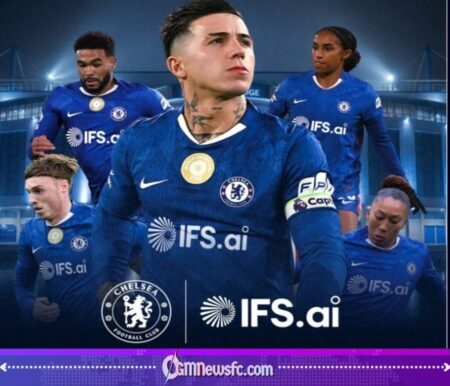
Chelsea Football Club have officially confirmed a front-of-shirt sponsorship agreement with IFS, marking the end of a prolonged search for a consistent principal partner. The Swedish industrial AI company will see its logo emblazoned across the club’s iconic blue shirts, bringing fresh commercial stability to Stamford Bridge.
For a club that has navigated ownership changes, financial recalibration and a competitive rebuild in recent seasons, securing a recognizable global sponsor represents more than branding — it signals regained commercial traction. The deal has been described as a multi-year global partnership, although the shirt placement is currently confirmed through the end of the 2025/26 season.
Chelsea supporters, long accustomed to high-profile sponsors, will now have to get familiar with a tech name rooted less in mobile networks and more in industrial artificial intelligence. It may not roll off the tongue in the pub — but in boardrooms, it carries weight.
Who Exactly Are IFS?
Founded in Sweden in 1983, IFS (Industrial and Financial Systems) is a global enterprise software and industrial AI company providing advanced solutions in asset management, manufacturing, energy and aerospace sectors. In short, they specialize in using data and artificial intelligence to make complex operations run more efficiently.
While IFS might not be a household name in football circles, the company has steadily expanded its footprint in global sports sponsorships. Its strategy is clear: align industrial precision with elite performance brands. Football, with its blend of analytics, data science and marginal gains, fits neatly into that narrative.
Chelsea executives have emphasized that this is more than a shirt logo arrangement. The partnership is expected to include collaborative innovation in analytics, operational efficiency and potentially performance optimization — though the club stopped short of detailing how far the AI integration will stretch.
From Sponsor Drought to Digital Deal
Chelsea’s shirt sponsorship journey over the past few seasons has been eventful. Following the expiration of previous agreements, the club operated without a long-term front-of-shirt sponsor, occasionally featuring short-term or transitional branding.
The absence of a stable principal partner had been viewed as both a financial and symbolic gap for a club competing in the highly commercialized environment of the Premier League. In England’s top flight, shirt sponsorship is not merely aesthetic — it represents a significant revenue stream and a signal of global market appeal.
With IFS stepping in, Chelsea have plugged that commercial hole. While financial figures remain undisclosed, industry observers suggest the deal strengthens the club’s commercial portfolio at a critical moment in its sporting rebuild.
What This Means for the Men’s and Women’s Teams
The IFS branding will appear across both the men’s and women’s first-team kits. That inclusive rollout reflects modern sponsorship strategy — ensuring visibility across competitions and audiences rather than limiting exposure to a single squad.
For Chelsea’s women’s team, among the strongest in Europe, the partnership adds further commercial credibility. For the men’s team, it arrives at a time when performances are under scrutiny and rebuilding efforts are ongoing.
Moderate humor aside, supporters may joke that if industrial AI can optimize global supply chains, perhaps it can also fine-tune defensive positioning. Officially, though, the focus remains commercial alignment rather than tactical intervention.
The Business of Football Meets the Business of AI
Modern football clubs are increasingly data-driven enterprises. Recruitment analytics, fan engagement metrics, sports science modeling and commercial forecasting are now embedded into elite operations. Partnering with an AI-driven enterprise firm therefore reflects the broader convergence between technology and sport.
Chelsea leadership described the agreement as a “statement of intent,” highlighting innovation and long-term collaboration. IFS executives, in turn, spoke of precision, performance and ambition — language that comfortably overlaps with elite football culture.
Whether the partnership ultimately becomes transformative or remains primarily symbolic will depend on execution. For now, the most visible change is straightforward: a bold new logo across the blue shirt, photographed, scrutinized and debated across global football media.
A Strategic Move in a Competitive Market
In the fiercely competitive Premier League commercial landscape, sponsorship deals carry strategic importance beyond immediate revenue. They enhance brand value, global visibility and investor confidence.
For Chelsea, whose recent seasons have involved transition both on and off the pitch, the IFS agreement provides a measure of stability. It also demonstrates that despite fluctuations in league position, the club remains commercially attractive to multinational corporations.
If football is increasingly about marginal gains, Chelsea’s latest move may represent one in the boardroom rather than on the training pitch. And in the modern game, those margins matter just as much.