



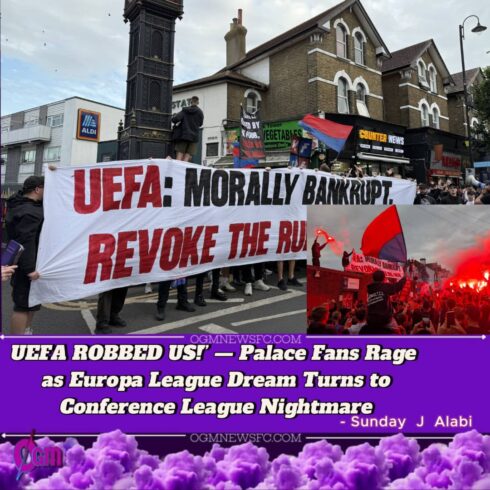
Crystal Palace supporters have taken to the streets in a passionate protest against UEFA’s decision to demote the club from the Europa League to the third-tier UEFA Conference League. On Tuesday, hundreds of fans clad in red and blue marched to Selhurst Park, chanting slogans and waving banners condemning European football’s governing body.
The demonstration came in the wake of Crystal Palace’s demotion despite qualifying for the Europa League by winning the FA Cup in May — the club’s first major trophy in history. The protest was organised by multiple fan groups, including The Holmesdale Fanatics and the Red and Blue Review podcast, in what they described as a stand “against injustice and bureaucratic betrayal.”
Among the chants heard during the march were “UEFA out!” and “We earned it on the pitch!” Banners read messages such as “Let us play, we earned our way” and “Don’t punish the fans for boardroom politics.” Fans also staged a 15-minute silent protest outside the club’s gates before dispersing peacefully.
The Controversy: Multi-Club Ownership Breach
At the heart of the issue is UEFA’s strict regulation on multi-club ownership. According to the governing body’s rules, no two clubs with shared ownership or substantial influence from the same individual or entity can compete in the same European competition. Crystal Palace and French side Lyon — both with ownership links to American businessman John Textor — had qualified for the Europa League, triggering the conflict.
UEFA had set a deadline of 1 March 2025 to restructure such ownership overlaps. However, Crystal Palace failed to meet this requirement in time, resulting in their forced demotion to the Conference League. Textor, who owns a minority stake in Palace and is the majority owner of Lyon, is now in the process of selling his Crystal Palace shares to New York Jets owner Woody Johnson — a deal that came too late to affect UEFA’s decision.
This ruling means Nottingham Forest, who finished seventh in the Premier League, are now poised to replace Palace in the Europa League — a move that has further enraged Eagles supporters and management alike.
“A Terrible Injustice” – Crystal Palace and Fans Speak Out
Crystal Palace chairman Steve Parish did not mince words in his reaction last week, calling UEFA’s ruling “a bad day for football” and “a terrible injustice.” Parish argued that the club has been “locked out of a European competition on the most ridiculous technicality,” and insisted that Crystal Palace fully deserved their Europa League place on sporting merit.
Fan spokesperson Nick Philpot, speaking during the march, echoed that sentiment: “At the end of the day, it’s an injustice, just by a couple of admin errors. We qualified for it. We won the cup — it should be a straight ticket in. You’re penalising the entire club and the fanbase. Why would you do that?”
Supporters are especially angered by the fact that the punishment does not stem from match-fixing or doping, but from corporate structure — something entirely out of the control of players and fans. The sentiment is widespread: UEFA’s decision, in their view, undermines the spirit of fair competition and turns football into a game governed by backroom dealings rather than on-field success.
Legal Battle Looms: CAS Appeal on the Horizon
Crystal Palace are expected to challenge UEFA’s decision by taking the case to the Court of Arbitration for Sport (CAS). Legal experts believe the case could hinge on whether Crystal Palace’s restructuring efforts — though not complete by UEFA’s deadline — demonstrate a clear intent to comply and mitigate any perceived conflict of interest.
A successful appeal could potentially open the door for Crystal Palace to be reinstated into the Europa League, though such a verdict might come too late to affect the 2025/26 campaign. Regardless, the club’s leadership believes it is a fight worth having — not just for Crystal Palace, but for the principle of sporting merit in European football.
A spokesperson for UEFA said it “respects all clubs’ right to appeal,” but maintained that its rules are “essential to preserving integrity and transparency in continental competitions.”
What’s Next – And What Does This Mean for Football?
The situation raises broader questions about UEFA’s approach to multi-club ownership, a growing trend in global football. As more investors buy into multiple teams across leagues and borders, the need for flexible yet fair governance becomes increasingly urgent.
For Crystal Palace, the Conference League represents their first taste of European football since 1998 — yet rather than being a moment of unbridled joy, it has been tainted by controversy. Fans, players, and staff are left wondering what their cup triumph really earned them, and whether financial influence now trumps footballing achievement.
As one fan bluntly put it during the protest: “If winning a trophy doesn’t guarantee you your rightful place in Europe anymore, then what’s the point of playing?”
#