






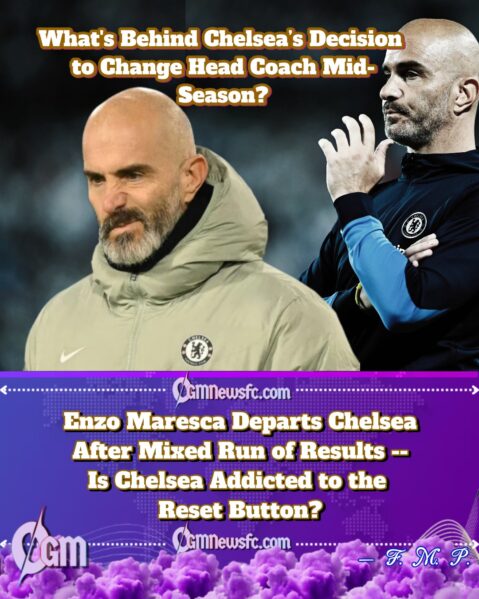
Chelsea’s hierarchy are many things, but patient is rarely one of them. On paper, Enzo Maresca’s reign at Stamford Bridge didn’t scream disaster: fifth in the Premier League, a Club World Cup trophy still warm enough to double as a hand warmer, and a squad finally starting to resemble a football team rather than a football experiment. Yet football, especially at Chelsea, is not played on paper—it’s played on mood, momentum, and Monday-morning meetings. One league win in seven, December points evaporating like mist over the Thames, and suddenly the emergency glass was smashed.
What followed was a familiar West London storyline: polite statements, awkward silences, players posting thank-you messages, fans splitting into camps, and another head coach added to the ever-growing Stamford Bridge managerial museum. Enzo Maresca is out. Again, Chelsea remind the football world that stability is optional, not mandatory.
Results vs Reality: When the Table Lies (a Little)
From a purely numerical standpoint, Chelsea’ were not in free fall. Fifth place kept them within touching distance of the Champions League conversation, and silverware—actual, physical trophies—sat proudly in the cabinet. For many clubs, that would be a season to protect and build on. At Chelsea, it was merely a starting point for scrutiny.
The problem was not where Chelsea were, but how they got there. Performances in December lacked bite, control, and—perhaps most unforgivable of all—certainty. One win in seven league games felt less like a wobble and more like a warning sign written in bold font. To ownership, the trend line mattered more than the snapshot.
In short, Chelsea’ didn’t sack Enzo Maresca for being fifth. They sacked him for looking like he might finish sixth.
The Dressing Room Temperature Check
Inside the squad, reactions were mixed but polite—football’s universal language for “this was complicated.” Several players publicly thanked Enzo Maresca for his guidance, tactical clarity, and man-management, suggesting a coach who was respected even if not universally adored.
Privately, however, sources pointed to a growing sense of uncertainty. Tactical tweaks became frequent, instructions more detailed, and confidence harder to sustain when results didn’t follow. Players, like fans, can sense when a manager’s authority is being quietly audited upstairs.
It wasn’t mutiny. It was mood. And at elite clubs, mood often decides outcomes long before results do.
Boardroom Banter Turned Boardroom Breakdown
Behind the scenes, the real drama unfolded far from the pitch. Reports spoke of blocked plans, strategic disagreements, and a relationship that went from collaborative to cautious. Executives prefer alignment; Maresca preferred autonomy. Neither side blinked.
Eyebrows were raised by public comments that hinted at frustration without fully explaining it. In modern football, silence is suspicious—but so is speaking too freely. Enzo Maresca’s remarks landed awkwardly, prompting internal questions about messaging, loyalty, and long-term compatibility.
By the time Chelsea’s New Year content rolled out—noticeably without their head coach—the subtext was louder than any press release.
Style, Substance, and the Chelsea Identity Question
Enzo Maresca arrived with a clear footballing philosophy: structured buildup, positional discipline, and patience in possession. At times, it worked beautifully. At others, it looked like a rehearsal running past its opening night.
Chelsea fans, long accustomed to chaos wrapped in trophies, struggled to decide whether they wanted process or punch. Ownership, meanwhile, wanted both—and quickly. The tension between long-term development and short-term expectation proved impossible to manage in December’s unforgiving fixture list.
The result was a philosophical mismatch. Not a failure of ideas, but a failure of timing.
Trophies Don’t Always Buy Time As Enzo Maresca Learns In A Hard Way
Winning the Club World Cup should, in theory, grant a manager goodwill. At Chelsea, it granted a brief pause. The trophy validated Enzo Maresca’s methods but did not erase concerns about league momentum.
History suggests this is not unusual at Stamford Bridge. Trophies are celebrated, then archived. What matters next is the next match, the next run, the next board meeting. Maresca leaves as one of the more decorated recent Chelsea’ coaches—and one of the shortest-tenured.
It is a paradox only Chelsea could perfect.
Fans, Fallout, and the Familiar Feeling
Supporters reacted as they always do: loudly, instantly, and in disagreement. Some argued Chelsea had pressed the panic button too soon. Others believed the club had simply acted according to its DNA—ruthless, reactive, and relentlessly ambitious.
What united everyone was recognition. This felt familiar. Another project paused mid-sentence. Another manager thanked for his service. Another reminder that at Chelsea, progress must be both visible and immediate.
Stability, once again, was deferred.
Chelsea Move On, As They Always Do: Life After Enzo Maresca
Enzo Maresca leaves Stamford Bridge with medals, memories, and the knowledge that he survived longer than most. Chelsea move on with a squad still talented, a season still salvageable, and a reputation intact—for better or worse.
The cycle continues. The cabinet remains shiny. And somewhere in West London, the emergency glass has already been replaced.