









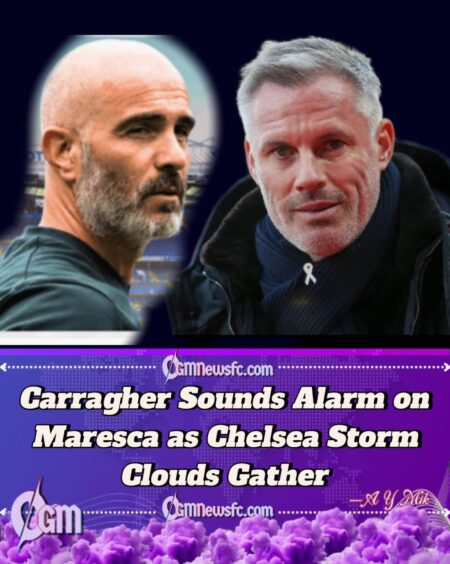
Jamie Carragher has never been one to sugarcoat football realities, and his latest verdict on Chelsea manager Enzo Maresca landed with the subtlety of a two-footed tackle. Speaking during his punditry duties, the former Liverpool defender warned that Maresca may have created “a big problem” for himself at Stamford Bridge by publicly hinting at a lack of internal support.
Carragher went further than mild concern. He boldly suggested that if the situation continues on its current path, Maresca might not even be in the Chelsea dugout next season. For a club with a famously itchy trigger finger when it comes to managers, that statement alone was enough to set alarm bells ringing across west London.
Maresca’s ‘Worst 48 Hours’ and the Comment That Lit the Fuse
The controversy stems from Maresca’s post-match comments in which he described the previous 48 hours as the “worst” of his Chelsea tenure. More importantly, he implied that he had not received the level of support he expected — without clarifying whether his frustration was aimed at the club’s hierarchy, staff, players, or the surrounding media circus.
That ambiguity proved costly. In modern football, vague statements rarely stay vague for long. Instead, they morph into headlines, speculation, and boardroom unease. As Carragher and others pointed out, when a manager publicly questions support, it often signals deeper internal cracks — or at least invites the perception of them.
Chelsea’s Boardroom Reality: Sympathy Is Not a Strategy
Carragher’s warning wasn’t just about Maresca’s words; it was about Chelsea’s culture. The club’s recent history shows little patience for public dissent, especially from managers still trying to establish authority. From boardroom reshuffles to rapid-fire managerial changes, Chelsea has become a place where survival depends as much on diplomacy as tactics.
While Maresca may feel aggrieved, Carragher argued that airing those grievances publicly weakens his position. In simple terms: football boards may listen in private, but they rarely forgive in public. At Chelsea, that lesson has been taught repeatedly — usually with a termination letter attached.
Pundits Divided: Is Maresca the Problem or the Victim?
Not all reaction has been critical. Some analysts believe Maresca’s honesty reflects the pressure cooker environment at Chelsea rather than managerial incompetence. They argue that constantly changing coaches and structures makes it difficult for any manager to thrive, let alone one still embedding his ideas.
However, Carragher’s camp remains firm: regardless of circumstance, top managers must choose their words carefully. In an era where every sentence is dissected, a poorly timed complaint can undo months of work. Sympathy, as one pundit joked, does not earn points on the league table — or extensions on contracts.
The Dressing Room Effect: When Players Start Reading Between the Lines
Beyond the boardroom, there is also the dressing room to consider. When a manager hints at a lack of support, players inevitably wonder who is backing whom. Are decisions being questioned upstairs? Is the project still trusted? Those doubts, once planted, are difficult to remove.
Carragher subtly highlighted this risk, noting that players often sense instability long before results reflect it. At a club already struggling for consistency, the last thing Chelsea need is uncertainty filtering down from press conferences into performances on the pitch.
What Happens Next: Calm Talks or the Start of the Countdown?
Maresca has since insisted he remains committed to Chelsea and downplayed the idea of an internal crisis. That may buy him some breathing room, but as Carragher suggested, the clock may already be ticking. Chelsea’s hierarchy are known to plan contingencies early, even while publicly backing their man.
For now, the ball is in Maresca’s court. Results can silence noise faster than any clarification. But if performances wobble and comments continue to raise eyebrows, Carragher’s “bold prediction” may start to look less like pundit drama and more like football prophecy.