










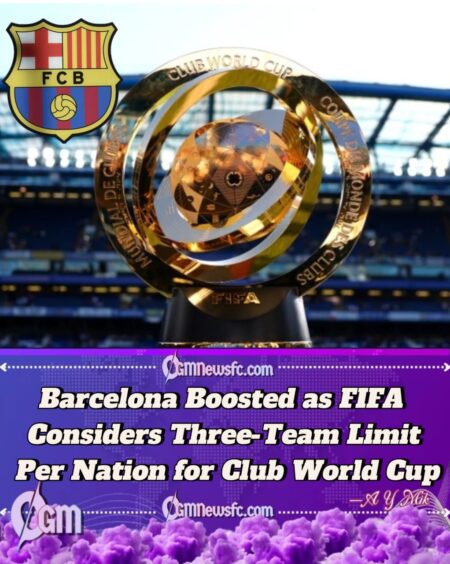
FIFA is reportedly working on a new strategy aimed at ensuring that Europe’s most successful clubs, including FC Barcelona, are not sidelined in future editions of the FIFA Club World Cup. According to reports from Mundo Deportivo, the governing body is considering increasing the number of clubs allowed per country from two to three.
This move would help domestic champions like Barcelona, who missed the last tournament despite winning La Liga, gain automatic access without being forced to rely solely on UEFA’s coefficient system. Similar disappointments were experienced by Liverpool in England and Napoli in Italy, raising widespread concerns about the fairness of the qualification structure.
FIFA’s proposal comes as the organization faces mounting pressure to balance competitive integrity with commercial appeal. By granting extra slots per nation, the competition could ensure that elite clubs consistently feature, boosting global interest and revenue.
Barcelona’s Painful Absence from the Last Club World Cup
Barcelona’s omission from the most recent Club World Cup was a major talking point across Europe. Despite lifting the La Liga trophy, the Catalan giants were excluded due to FIFA’s current qualification format, which prioritizes Champions League winners and clubs with the highest coefficient ranking over the past four years.
For Barcelona, the snub was not only a blow to their global reputation but also a missed financial opportunity. The Club World Cup is fast becoming a global spectacle with lucrative sponsorships and broadcasting rights. Missing out meant reduced visibility, fewer commercial deals, and lost opportunities to compete against the world’s top teams.
Liverpool and Napoli also found themselves on the wrong side of the rules, despite achieving domestic success in their respective leagues. This raised debates within the football community about whether the current system unfairly sidelines deserving champions while favoring clubs that thrive in Europe’s top-tier competitions.
FIFA and UEFA Locked in Talks Over Tournament’s Future
As FIFA looks to reshape the Club World Cup, negotiations with UEFA have become critical. The world’s governing body is eager to expand the competition to 48 teams, potentially introducing the format as early as 2029. FIFA also wants to stage the tournament every two years to maximize global exposure and revenues.
However, UEFA has expressed resistance to these ideas, citing the already congested European football calendar. Adding a biennial mega-tournament would put significant strain on clubs, players, and domestic leagues. European football’s governing body believes that player welfare and scheduling must take precedence over FIFA’s commercial ambitions.
These discussions are far from settled, but compromise will be essential. Without UEFA’s cooperation, FIFA risks alienating Europe’s elite clubs and undermining the competition’s credibility. At the same time, the governing body is determined to create a truly global event that rivals the scale of the FIFA World Cup.
Why Barcelona Stands to Benefit from the New Proposal
If FIFA’s proposed changes are approved, Barcelona would be one of the biggest beneficiaries. The club has been rebuilding under Hansi Flick, and participation in the expanded Club World Cup would offer both sporting and financial advantages.
For the team, it would mean an opportunity to face off against top clubs from South America, Asia, and beyond, showcasing their talent on a global platform. For the club’s finances, the additional exposure would likely attract sponsorships, strengthen merchandising sales, and provide much-needed prize money at a time when Barcelona continues to battle financial instability.
The proposed three-team limit per nation would also create a more balanced representation of European football. With Spain often producing multiple world-class teams, including Real Madrid and Atlético Madrid, the new rule would ensure that Barcelona’s achievements do not go unrecognized in global competitions.
Global Expansion and the Challenge of Balancing Calendars
FIFA’s ambition to expand the Club World Cup is part of its broader plan to globalize football beyond Europe and South America. A 48-team tournament would provide opportunities for clubs from Africa, Asia, and North America to compete on equal footing with Europe’s heavyweights.
For fans, this expansion promises more diverse matchups and a celebration of football’s global reach. For FIFA, it represents a chance to generate unprecedented commercial revenue, tapping into growing markets across Asia and the Americas.
Yet, the challenges remain significant. Player workload has already become a growing concern, with top stars often playing upwards of 60 matches per season. Critics argue that adding a biennial Club World Cup risks overextending players, increasing injury rates, and diminishing the quality of competitions such as the Champions League, domestic leagues, and even international tournaments.
The Road Ahead: A Lifeline for Barcelona and Others
Looking ahead, the proposed changes represent a potential lifeline for Barcelona. Participation in the Club World Cup would restore their presence on the world stage, offering the club a chance to rebuild its global dominance after years of financial turbulence and inconsistent results in Europe.
For fans, it would reignite excitement about seeing Barcelona compete against the likes of Flamengo, Al Ahly, or Mexican powerhouses on a regular basis. For FIFA, ensuring clubs like Barcelona, Liverpool, and Napoli feature in the tournament guarantees higher viewership and commercial success.
The final decision on the tournament’s structure, format, and host nation is expected to be announced in the coming years. Until then, Barcelona and other top clubs will closely monitor FIFA’s negotiations with UEFA, hopeful that the new rules will create a fairer and more inclusive pathway to one of football’s most prestigious global stages.