



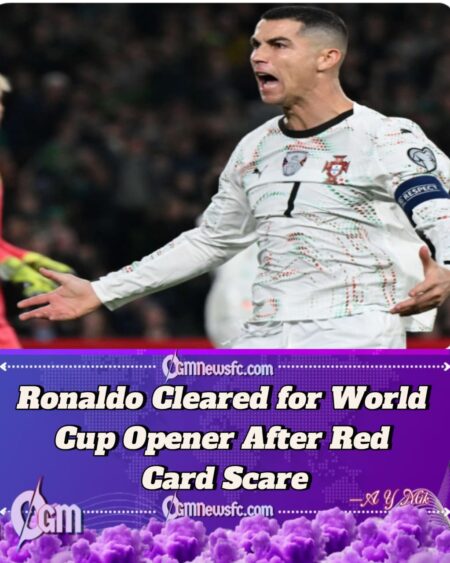
Cristiano Ronaldo’s 226-match streak without a red card for Portugal came to a sudden, dramatic end in Dublin when he was sent off during Portugal’s 2–0 loss to the Republic of Ireland. The incident—an untidy elbow into the back of Dara O’Shea—left the Irish defender on the turf and the Aviva Stadium roaring with equal parts shock and satisfaction.
VAR took its time, cameras zoomed in, referees discussed, and eventually Ronaldo was shown a straight red. Even at 40 years old, the Portuguese captain still finds himself in the headlines with a flair for the dramatic. Only this time, it wasn’t for a hat-trick, a record, or a viral celebration… but for an elbow that had the football world buzzing.
For many fans, the moment felt surreal. Some joked that an eclipse is more common than seeing Ronaldo sent off internationally. But jokes aside, the incident left a major question hanging over Portugal’s World Cup hopes: would their talisman miss the opening matches?
FIFA Steps In: The Verdict Everyone Held Their Breath For
As expected, the case went straight to FIFA’s disciplinary committee. Normally, violent conduct—especially off the ball—comes with a minimum of a three-match ban. Portuguese fans braced for impact. Rival fans prayed for entertainment.
After days of deliberation, FIFA released its ruling: a one-match ban (already served) and a suspended two-match ban, meaning Ronaldo is fully cleared to play Portugal’s opening game at the 2026 World Cup. Relief swept across Portugal faster than a Ronaldo free-kick.
The committee cited his “exceptional disciplinary record” and the fact that this was his first-ever red card for Portugal in over two decades of service. In essence: yes, it was violent conduct—but no, they weren’t about to send one of the game’s biggest icons into a World Cup with a cloud hanging over his legacy.
Suspended Ban: The Sword Hanging Over CR7’s Head
While the decision allows Cristiano Ronaldo to play the World Cup opener, the two-match suspended ban remains a ticking disciplinary time bomb. If he commits another offence classified as violent conduct within the next year, the ban will activate instantly.
This means Ronaldo will be walking into the World Cup not just with cameras everywhere, but also with disciplinary laser sensors. Every jump, every tussle, every shoulder-to-shoulder challenge will be studied like a science experiment.
The Portuguese captain is known for passion and fire, but now a single ill-timed swing of the elbow—or shruggish frustration—could see him sitting out vital matches. Portugal’s coaching staff will undoubtedly be whispering “calma, calma” into his ear before every game.
Ireland’s Reaction: “We’ll Take the Win, But Really?”
In Ireland, the red card was celebrated almost as much as the rare win over Portugal. Fans who witnessed the elbow expected FIFA to throw the book at Ronaldo—possibly the bookshelf while they were at it. Many Irish pundits expressed surprise at the leniency, though not necessarily shock; after all, football has a long history of star players receiving “celebrity justice.”
The Irish camp maintained professionalism, with O’Shea himself brushing off the incident and saying the referee did his job. But Irish supporters on social media were less diplomatic, with some humorously suggesting that if they elbowed someone like that at their workplace, they’d be fired, sued, and featured on a warning poster in HR.
Still, the 2–0 victory stands, the bragging rights are secure, and Ireland has a quirky footnote in football history: the team that handed Ronaldo his first-ever international red card.
Portugal Breathes Again: Their Legend Marches On
For Portugal, this ruling feels like a divine intervention. Cristiano Ronaldo remains central to the team’s attack—even at 40—and his leadership is irreplaceable. Missing him for the World Cup opener would have been a tactical headache and a morale blow.
The coaching staff and players reacted with visible relief after the verdict. The Portuguese media framed it as a “just outcome,” highlighting his stellar disciplinary history and immense contribution to global football. Many fans simply thanked the football gods and went back to planning their World Cup watch parties.
With Cristiano Ronaldo available, Portugal enters the tournament with full attacking power and a stronger sense of stability. Now the focus shifts from courtroom drama back to football, where Ronaldo can once again chase records rather than disciplinary hearings.
Global Reaction: “Big Name Privilege, or Fair Justice?”
As expected, the global football community was divided. Neutral fans questioned whether a lesser-known player would have received the same leniency. Analysts suggested that FIFA might have weighed the commercial and narrative value of having Ronaldo in the opening matches of the World Cup.
Meanwhile, football romantics celebrated the idea of watching Ronaldo grace the world stage one last time. Headlines across Europe and South America framed it as a win for the sport, while a few tabloids called it “Ronaldo’s Great Escape.”
Whether one sees it as fair or fortunate, one thing is clear: the 2026 World Cup just got a lot more exciting with the tournament’s most decorated veteran firmly in the spotlight.
Ronaldo’s Road to His Sixth World Cup
At 40, Ronaldo is heading into his sixth World Cup—an unprecedented achievement for an outfield player. His fitness regime continues to amaze scientists, football fans, and probably a few agricultural equipment manufacturers.
With this disciplinary cloud now lifted, Ronaldo can focus on preparing mentally and physically for what may be his final World Cup. The stage is set, the cameras are ready, and the world waits once again to see what CR7 will deliver.
For Portugal, hopes are high. For neutrals, entertainment is guaranteed. And for Ronaldo, the mission is simple: one last dance, no elbows.