









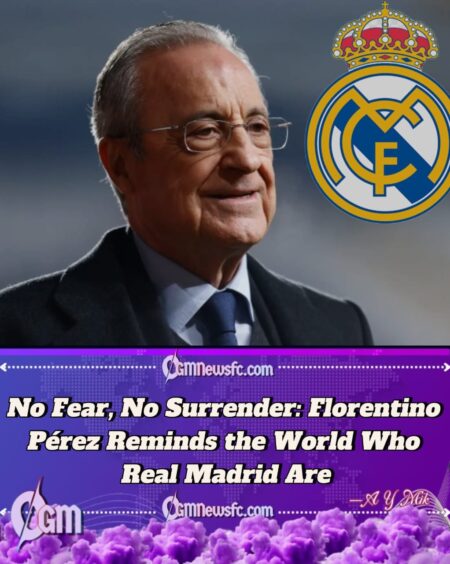
As Real Madrid prepared for yet another high-stakes Spanish Super Cup final, club president Florentino Pérez stepped forward not with a tactical board or transfer rumors, but with words—carefully chosen, emotionally loaded, and unmistakably Madrid. His message to fans was short, defiant, and deeply familiar: Real Madrid does not surrender. Ever.
Delivered in Saudi Arabia, where the Super Cup final was staged, Pérez’s address blended history, belief, and a reminder that wearing white comes with responsibility. It was not just a pep talk—it was a reminder of identity.
A President, a Podium, and a Promise
Florentino Pérez addressed Real Madrid supporters at a fan gathering near the team’s base ahead of the final, thanking them for travelling across continents to support the club. He acknowledged the sacrifices made by fans and stressed that their presence fuels the team in decisive moments.
With calm confidence, Pérez reminded the audience that Real Madrid’s story has never been about easy victories. Instead, it has been about persistence—about standing tall when the pressure is highest. His now-viral line, “We never give up,” was met with loud approval, as if fans were completing the sentence before he finished it.
There was no shouting, no theatrics. Just a man who has seen it all—late goals, miracle comebacks, impossible nights—speaking like someone who expects history to repeat itself.
The Weight of the White Shirt
Pérez leaned heavily on symbolism, particularly the iconic white jersey. According to him, the shirt is not just fabric but a witness to footballing history—Champions League finals, Clasico triumphs, and moments that have broken rival hearts across Europe.
He reminded fans that when players put on the Real Madrid shirt, they are carrying decades of expectation. The message was clear: the badge alone does not win matches, but it demands a certain attitude—fight until the final whistle, even when logic says otherwise.
In typical Madrid fashion, the subtext was subtle but sharp: if you think the match is over before the final whistle, then you probably haven’t watched Real Madrid long enough.
Numbers That Speak Louder Than Noise
Pérez did not shy away from statistics. He highlighted the club’s remarkable trophy haul over the last 15 years, pointing to domestic and European dominance that few clubs can even dream of matching.
These numbers were not shared to boast—at least not openly—but to remind fans and players alike that success is not accidental. It is built on a culture of refusal: refusal to accept defeat, refusal to settle, refusal to panic when things go wrong.
With rivals enjoying short-term highs and louder social media moments, Pérez’s calm listing of trophies felt like a quiet mic drop. After all, history does not trend—it endures.
El Clásico, Pressure, and the Art of Thriving
The timing of the speech mattered. This was not just any final—it was El Clásico, football’s most emotionally charged rivalry. Pérez acknowledged the magnitude of the occasion, noting that these matches test not only skill, but character.
He emphasized that Real Madrid’s greatest strength has never been comfort. The club, he implied, performs best when challenged, doubted, or written off. Finals against Barcelona are not feared in Madrid—they are embraced.
In a subtle dose of humor, one could read between the lines: if things get tense, dramatic, or chaotic, Real Madrid fans should feel right at home.
More Than Words: A Message to the Dressing Room
While the speech was directed at supporters, its echo was clearly meant for the players. Pérez stressed that the squad feels the fans’ presence and carries their belief onto the pitch.
He spoke of unity—between players, fans, and the institution itself—describing Real Madrid as a family bound by shared values and relentless ambition. The message was unmistakable: excuses are not part of the club’s vocabulary.
As the final approached, Pérez left supporters with reassurance rather than predictions. He did not promise victory. He promised effort. And in Madrid, that promise often ends with silverware.