


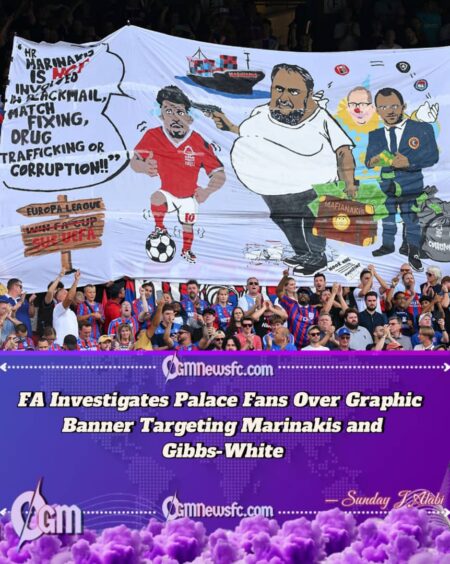
The Football Association has launched an investigation after Crystal Palace fans displayed a graphic banner depicting Nottingham Forest owner Evangelos Marinakis holding a gun to the head of midfielder Morgan Gibbs-White during Sunday’s 1-1 draw at Selhurst Park.
The banner, raised by supporters in the Holmesdale End, went beyond simple rivalry and drew immediate condemnation due to its violent imagery and defamatory references. It also featured Marinakis holding a briefcase stuffed with cash, a ship bearing his name, and caricatures of UEFA officials and former Palace minority shareholder John Textor. Gibbs-White, who recently signed a new deal with Forest after turning down Tottenham Hotspur, was shown in the graphic with a speech bubble sarcastically denying long-standing allegations against Marinakis — accusations the Greek businessman has always vehemently denied.
Though not shown during Sky Sports’ UK broadcast, images of the banner quickly circulated online, prompting the Football Association to confirm that it would investigate whether the content breached Law 12, which prohibits displays deemed “provocative, derisory or inflammatory.”
Background: A Summer of Bitter Tensions
The flashpoint banner was the latest expression of animosity between the two clubs, whose rivalry has deepened following UEFA’s controversial ruling earlier this month. Palace, who had qualified for the Europa League by stunning Manchester City in the Football Association Cup final, were demoted to the Conference League due to ownership conflicts involving Textor’s simultaneous control of Lyon.
UEFA upheld the decision at the Court of Arbitration for Sport (CAS), handing Forest a late promotion into the Europa League at Palace’s expense. Reports indicated Marinakis had written to UEFA seeking clarification over Palace’s eligibility, something Palace fans interpreted as a decisive factor in their exclusion.
Palace chairman Steve Parish added fuel to the fire when he hinted on a podcast that Forest had benefited from their misfortune. Although Forest insist their correspondence was merely procedural and that UEFA was already investigating, Palace supporters clearly view Marinakis as the architect of their demotion.
Club Policies and Football Association Regulations Under Scrutiny
Crystal Palace’s own website explicitly warns that banners containing offensive or defamatory content will not be permitted at Selhurst Park. The Holmesdale Fanatics, the vocal supporters’ group responsible for Sunday’s display, declined to comment when approached by the media.
The Football Association has precedent in dealing with provocative banners. In 2021, Palace supporters were investigated after unveiling a controversial graphic targeting Saudi Arabia’s Public Investment Fund following Newcastle United’s takeover. While police eventually took no further action, the episode highlighted the fine line between political protest and defamatory imagery.
In this case, the inclusion of Gibbs-White — an active Premier League player — alongside the suggestion of violent coercion is expected to strengthen the Football Association’s case for disciplinary measures. Sanctions could range from fines and stadium bans to more severe penalties depending on the findings.
Repercussions for Palace, Forest, and the Wider Game
The fallout from Sunday’s incident could stretch beyond disciplinary matters. Palace, already bruised by UEFA’s ruling, now face questions about supporter conduct and stadium control. Any punishment could exacerbate frustrations within the club’s fanbase, which has grown increasingly hostile toward European football authorities and Marinakis in particular.
For Nottingham Forest, the banner represents a direct attack on both their owner and captain, raising concerns over player welfare. Gibbs-White, who only weeks ago committed his future to the club until 2028 after rejecting Spurs, may feel unfairly targeted amid a storm of off-field politics.
The wider footballing community will also be watching the Football Association’s response closely. English football has worked in recent years to clamp down on offensive supporter behaviour, from discriminatory chants to dangerous pitch invasions. Allowing violent or defamatory imagery to pass unchecked could set a damaging precedent.
Rivalry That Shows No Signs of Cooling
The Palace-Forest saga is emblematic of how modern football’s off-pitch disputes — particularly around ownership structures and European qualification — can inflame supporter tensions. From “UEFA Mafia” banners to chants against Marinakis and Textor, Palace fans have consistently vented their anger over what they see as an unjust relegation from the Europa League.
With both sides now locked into the Premier League season and with European campaigns to juggle, further flashpoints seem inevitable. If Palace’s fortunes in the Conference League falter while Forest thrive in the Europa League, the resentment could deepen.
The Football Association’s verdict on the banner will be crucial in determining whether boundaries of supporter protest are clearly enforced or continue to blur in a climate where football politics often fuel fan expression. What is certain is that this controversy has ensured the Palace-Forest rivalry will remain one of the most heated narratives of the season.