








Former FIFA president Sepp Blatter has issued a stark warning about the state of global football, claiming the sport has been “lost” to Saudi Arabia. Speaking in a scathing interview with German television channel ntv, the 89-year-old Swiss football administrator said FIFA has essentially handed over control of the game to the oil-rich Middle Eastern nation, offering no resistance as the Saudis cement their grip on the sport’s most valuable assets.
“We have lost football to Saudi Arabia,” Blatter said. “We offered it, and they took it. Surprisingly, there is no opposition to this within FIFA.” His remarks follow Saudi Arabia’s uncontested bid to host the 2034 FIFA Men’s World Cup — a development that sealed the country’s growing dominance over international football.
Blatter’s criticism reflects widespread unease about Saudi Arabia’s increasing influence in the sport. In 2023, the kingdom’s Public Investment Fund (PIF) took control of four major clubs in the Saudi Pro League — Al Nassr, Al Hilal, Al Ittihad, and Al Ahli. It also owns 85% of Premier League club Newcastle United. Many observers say the financial muscle and political leverage that Saudi Arabia wields are reshaping football’s structure and values at the global level.
FIFA Accused of Enabling Saudi Expansion
The former FIFA boss did not hold back in his criticism of the organisation he once led, accusing it of surrendering without resistance to the Saudi government’s aggressive push into football. He pointed to the $1 billion Club World Cup broadcasting deal with streaming giant DAZN — a company now partially owned by Saudi Arabia’s sports investment arm, SURJ — as a prime example of how deeply entrenched Saudi interests have become within the FIFA ecosystem.
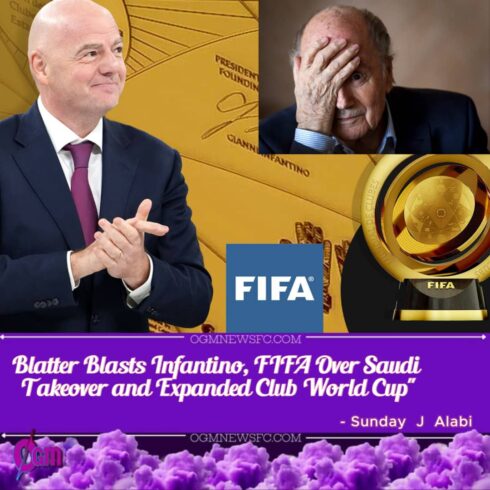
“Everything is done electronically, and nobody says anything,” Blatter said, referencing the lack of internal debate within FIFA about the implications of this power shift. “You can even arrive six hours late to a congress.” His dig appeared to reference current FIFA president Gianni Infantino, who delayed the May 2025 FIFA Congress in Paraguay after joining former U.S. president Donald Trump on a visit to Saudi Arabia and Qatar.
Additionally, Saudi brands such as Aramco, Riyadh Air, and Visit Saudi have become ubiquitous sponsors at high-profile club and international football events. Critics argue that FIFA is prioritizing lucrative deals over safeguarding the integrity and independence of global football governance.
Blatter Slams Expanded Club World Cup and Heat Risks
Blatter also voiced concern about FIFA’s newly-expanded 32-team Club World Cup format, calling it “unhealthy and impertinent.” The tournament, which debuted this summer in the United States, has been widely criticized for overloading the football calendar and subjecting players to extreme heat during peak afternoon kickoff times.
“There’s too much football,” Blatter said. “The same players and clubs are repeatedly affected, without adequate rest.” He added that the scheduling is particularly harmful, as matches played in dangerously high temperatures expose athletes to severe health risks. The players’ union, FIFPRO, has urged FIFA to reconsider afternoon kickoff times at “extremely high-risk” venues, but the governing body continues to prioritize European and Asian broadcast audiences.
FIFA has stated it is exploring the use of covered stadiums for matches held during the hottest hours, but Blatter insists these efforts are insufficient and reactive. “The players are the heart of the game,” he said. “They deserve better than to be treated like pawns in a global media circus.”
Infantino’s Leadership Under Fire
Blatter’s critique extended to his successor, Gianni Infantino, whose leadership style he described as detached and overly dependent on digital bureaucracy. “Everything is done electronically… no discussion, no accountability,” Blatter lamented. His comments reinforce a growing perception that FIFA’s current leadership is increasingly opaque and centralized.
Infantino’s recent decisions — including the last-minute delay of FIFA’s 2025 Congress and his close relationship with leaders in Saudi Arabia — have further strained trust among stakeholders. Many accuse him of turning FIFA into a vehicle for geopolitical influence rather than a steward of global football.
Blatter also decried Infantino’s apparent lack of urgency in addressing critical issues affecting the game. “We cannot allow the world’s most popular sport to be reduced to a commodity traded by a few powerful hands,” he warned.
A Controversial Legacy Comes Full Circle
Blatter’s statements come at a time when his own legacy remains contentious. Though cleared earlier this year of financial wrongdoing by a Swiss appeals court, his 17-year reign as FIFA president (1998–2015) was marred by corruption scandals and controversial World Cup awards to Russia (2018) and Qatar (2022). In 2022, Blatter admitted that awarding the tournament to Qatar was “a mistake.”
In 2015, he and former UEFA president Michel Platini were banned from football after FIFA’s ethics committee found them guilty of ethics violations linked to a 2 million Swiss franc payment. The ban was later reduced, and both men maintained the payment was delayed compensation for Platini’s advisory role, not a bribe.
Now back in the public eye, Blatter seems eager to position himself as a cautionary voice. While critics may question his credibility, his alarm over Saudi Arabia’s growing influence and FIFA’s complacency reflects broader fears about the future of football. As the sport hurtles toward a hyper-commercialized era, the question remains: who really owns the beautiful game?