








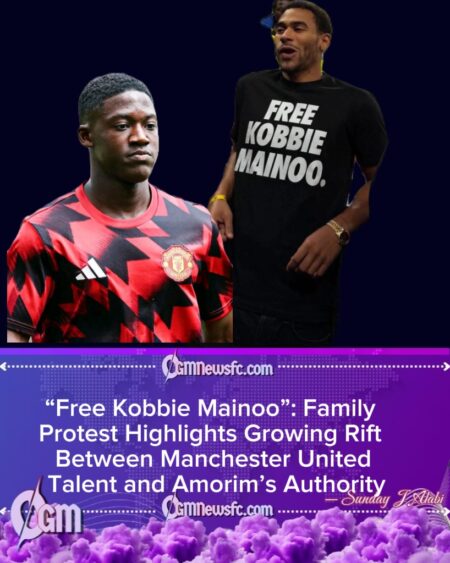
Manchester United’s turbulent season added another emotive subplot on Monday night as Kobbie Mainoo’s brother staged a highly visible protest inside Old Trafford, drawing fresh attention to the young midfielder’s uncertain future under head coach Ruben Amorim. The gesture, played out during a chaotic 4–4 Premier League draw with Bournemouth, underscored the growing tension between public expectation, managerial authority and the delicate handling of one of the club’s brightest academy graduates.
A Silent Protest That Spoke Loudly at Old Trafford
Amid the drama of United’s eight-goal thriller against Bournemouth, a different image circulated rapidly across social media and the stands. Jordan Mainoo-Hames, the older brother of Kobbie Mainoo and a former Love Island contestant, was spotted wearing a black T-shirt emblazoned with the words “Free Kobbie Mainoo.” The three-word slogan, stark and unmistakable, appeared to be a direct appeal to head coach Ruben Amorim over his brother’s lack of minutes.
The act was symbolic rather than confrontational, but its timing amplified its impact. With Old Trafford already restless following another inconsistent performance, the protest tapped into a broader frustration among supporters who believe Mainoo has been underused. For many fans, the message resonated as a plea to protect a homegrown talent at risk of stagnation.
Jordan Mainoo-Hames has been a visible supporter of his brother’s career progression, and Monday’s display reflected familial concern spilling into the public arena. While such interventions are rare in English football, they often emerge when players feel trapped between promise and opportunity.
Mainoo’s Marginal Role Under Amorim
Kobbie Mainoo’s season has been defined by fleeting involvement rather than sustained trust. Despite his reputation as one of United’s most composed young midfielders, the 20-year-old has yet to start a Premier League match this campaign. His total league involvement stands at just 212 minutes, with his latest appearance coming as a second-half substitute against Bournemouth.
Amorim has been firm in his assessment, insisting that Mainoo has not fully seized the chances presented to him. The Portuguese coach has argued that competition in midfield, combined with tactical demands, has limited opportunities not only for Mainoo but also for other academy prospects such as Toby Collyer, Chido Obi and Harry Amass.
For Mainoo, the concern is not merely the lack of starts but the absence of a defined pathway back into the XI. As January approaches, the sense is growing that a loan move may be necessary to ensure regular football at a critical stage of his development.
Legends Turn Critics as Pressure Mounts
The handling of Mainoo has drawn criticism from some of the most respected figures in Manchester United’s modern history. Rio Ferdinand, Paul Scholes and Nicky Butt have all publicly questioned Amorim’s approach, suggesting that prolonged inactivity could damage the midfielder’s long-term prospects.
Their argument is rooted in experience. Each benefited from trust placed in youth during United’s most successful era, and they see echoes of that potential in Mainoo. For them, a temporary departure from Old Trafford may be the best solution if opportunities remain scarce.
Amorim, however, has not shied away from responding to the criticism. He acknowledged the emotional connection former players feel towards the club but suggested that their expectations are shaped by a past defined by relentless winning—standards that no longer reflect United’s current reality.
Amorim’s Uncompromising Stance on Selection
Speaking ahead of the Bournemouth match, Amorim offered a candid assessment of both his position and the criticism he faces. He accepted responsibility for United’s underachievement, stressing that results ultimately define a manager’s freedom. “If I’m winning,” he remarked, “I can go to the games on a horse… and everything will be fine.”
The United boss also clarified his tactical reasoning, explaining that his preference for a two-man midfield limits Mainoo’s suitability in certain matches. He suggested that a system with three midfielders could naturally open more opportunities, but insisted that selections must serve the team first.
Amorim revealed that while he has held conversations with Mainoo in the past, discussions about a potential loan have not yet taken place. He maintained that player happiness matters, but not at the expense of collective balance or performance.
January Decisions and a Defining Moment Ahead
With the January transfer window approaching, Mainoo’s future appears increasingly uncertain. Napoli were his preferred destination when United blocked a loan move in the summer, and the Italian club are expected to renew their interest next month. For Mainoo, regular football may now outweigh the prestige of remaining at Old Trafford.
Manchester United’s academy tradition looms large in this debate, but Amorim has made it clear that sentiment will not dictate selection. Performance, tactical fit and results remain his guiding principles, even when they clash with public opinion or emotional appeals.
The sight of a “Free Kobbie Mainoo” T-shirt inside Old Trafford may fade quickly, but the questions it raised will not. As United search for stability and Mainoo seeks momentum, the coming weeks are likely to prove decisive—for both player and club.