









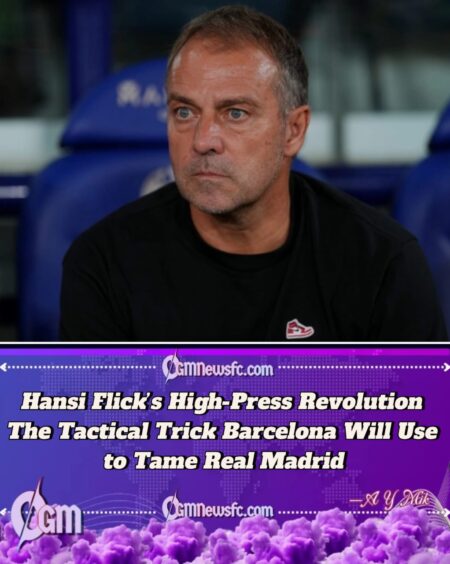
FC Barcelona manager, Hansi Flick has been meticulously crafting a strategy designed to outsmart Real Madrid as anticipation builds for the season’s first El Clasico. Reports from El País reveal that the German tactician has intensified training sessions at Ciutat Esportiva, focusing on structured high-pressing patterns meant to suffocate Madrid’s rhythm from the opening whistle.
In Flick’s latest session, the drills were not just about intensity—they were about precision. Each player had a clearly defined role, emphasizing positional discipline and transition speed. The German coach’s commitment to tactical detail reflects his belief that Barcelona’s path to victory lies in proactive football rather than reactive defending.
According to insiders, Flick and his assistant Marcus Sorg orchestrated several pressing rehearsals that mirrored in-game Madrid build-up sequences. These simulated drills aimed to prepare Barça’s players for every possible scenario Los Blancos could throw at them at the Santiago Bernabéu.
Player Roles in Flick’s Pressing Symphony
In Flick’s structured pressing scheme, every player is a moving cog in a synchronized machine. Fermin López was assigned the task of closing down Madrid’s right-back, ensuring that the opposition cannot progress easily down the flank. Meanwhile, Ferran Torres and Marcus Rashford were drilled to aggressively press the centre-backs, forcing hurried clearances and potential turnovers in dangerous zones.
Lamine Yamal’s role was particularly intriguing. Positioned to target Madrid’s left-back, Álvaro Carreras, the teenage sensation is expected to combine his explosive pace with tactical intelligence—pressing high while being ready to exploit space behind. This dual role makes Yamal both a defensive asset and an attacking weapon in transition.
Such clear individual responsibilities underline Flick’s belief in a collective system that thrives on unity and purpose. Instead of relying solely on defensive solidity, the focus is on pressing as a form of attack—a concept Flick has perfected since his days managing Bayern Munich.
The Philosophy Behind Flick’s High-Pressing Approach
Since arriving at Camp Nou, Hansi Flick has been determined to reintroduce the core principles of modern German football—energy, compactness, and relentless pressing. His teams do not just chase the ball; they hunt in packs. This philosophy is evident in Barcelona’s league statistics, with the side ranking among La Liga’s top teams for lowest PPDA (passes allowed per defensive action), a key metric indicating pressing intensity.
Flick’s philosophy revolves around immediate ball recovery once possession is lost. Instead of dropping deep to regroup, his players are instructed to swarm the ball carrier, forcing errors and regaining control in advanced positions. This proactive method reduces defensive exposure while maintaining attacking pressure.
By blending Barcelona’s traditional possession play with his high-energy pressing model, Flick is creating a hybrid identity—a team capable of dominating the ball but also suffocating opponents without it. This balance could be the defining factor in Sunday’s El Clasico clash.
The Leadership of Marcus Sorg in Flick’s Absence
While Flick serves a touchline suspension, his trusted assistant Marcus Sorg will lead from the bench. Yet, Sorg has made it clear that the team’s tactical DNA remains intact. “It’s an honour to be on the bench,” Sorg stated. “When Hansi isn’t there, you can feel his absence. He’s the most important part of the team.”
Despite Flick’s absence, Sorg’s experience ensures continuity. Having worked closely with Flick for years, he understands every detail of the German’s footballing philosophy. The coaching duo’s relationship is built on mutual trust and a shared tactical vision—one that prioritizes pressing, structure, and unity.
Sorg’s message to the players before the trip to Madrid was simple yet powerful: “We have to do our things well, press high, and keep our defensive line up. If we change anything, we lose our structure, and that doesn’t help.” This consistency of message guarantees that even without Flick’s physical presence, his tactical spirit will guide the team.
The Risks and Rewards of Barcelona’s High Press
High pressing against Real Madrid is both daring and dangerous. Flick’s setup demands total commitment, as one mistimed press can open spaces for Madrid’s lethal counterattack. Yet, the benefits are immense—forcing Madrid into rushed decisions, disrupting their build-up, and allowing Barça to control territory.
This approach particularly targets Madrid’s defenders, who can be unsettled when denied time on the ball. The pressing patterns aim to break their rhythm early, preventing Luka Modric or Jude Bellingham from dictating play. If executed perfectly, Barcelona could dominate possession and create scoring chances directly from turnovers.
However, the strategy requires discipline and fitness. Every forward movement must be synchronized with midfield and defense lines. Flick’s staff have worked extensively on conditioning and tactical spacing to ensure no gaps emerge during transitions. The El Clasico will ultimately test whether Barcelona can sustain this intensity for the full 90 minutes.
Confidence and Continuity as Barcelona’s Driving Forces
Despite recent injury concerns and questions over defensive depth, Barcelona’s camp exudes confidence. Flick’s training drills and Sorg’s consistency of message have built a sense of unity that mirrors the club’s historical DNA. The players know that victory in Madrid is not just about tactics—it’s about belief and collective effort.
The timing of the fixture could also favour Barça. Real Madrid’s busy schedule and moments of inconsistency have given Flick’s side reason to believe they can seize control early. The high-pressing game plan, though less glamorous than intricate tiki-taka, often proves decisive in clashes where intensity trumps elegance.
For Flick and Barcelona, El Clasico is more than a battle for points—it’s a test of a new footballing era under German discipline. If their pressing patterns succeed, it will signal that this Barcelona side is ready to reclaim dominance not just through possession, but through power, precision, and purpose.