



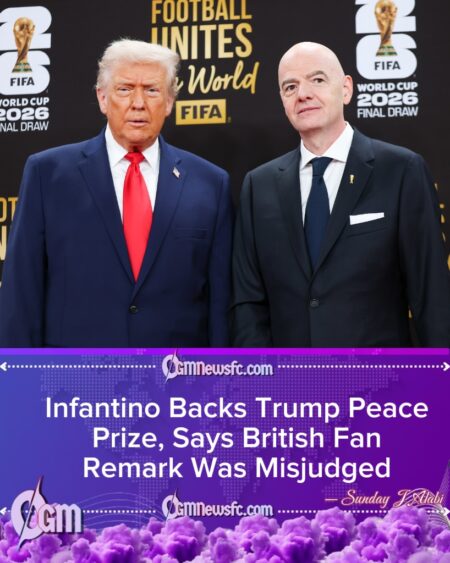
The President of the world football governing body, FIFA, Gianni Infantino, has issued an apology to British football fans over controversial remarks he made during the World Economic Forum in Davos, while also standing firmly by FIFA’s decision to award a peace prize to former United States President Donald Trump. In the same interview, Infantino addressed the possibility of Russia’s return to international football and dismissed fears of a boycott of upcoming World Cup tournaments.
Speaking in an interview with Sky News, Infantino sought to clarify his comments, which had sparked criticism from football supporters’ groups and law enforcement officials in the United Kingdom. He also defended FIFA’s broader political positioning, arguing that football should remain a platform for unity in a deeply divided global environment.
Controversial Comment on British Fans and Public Backlash
At the centre of the controversy was Infantino’s remark that the 2022 World Cup in Qatar was special because, for the first time, “no Brit was arrested.” The comment was widely criticised in the UK, with the Football Supporters’ Association describing it as a “cheap” joke that unfairly portrayed British fans.
Senior UK football policing officials also rejected the statement, noting that British supporters have maintained a largely positive record at major international tournaments both before and after Qatar. Critics argued that the comment reinforced outdated stereotypes and ignored decades of progress in football crowd management.
Infantino’s Apology and Clarification
Responding to the criticism, Infantino apologised and said the remark was intended to be light-hearted rather than offensive. He explained that his aim was to highlight the peaceful atmosphere of the Qatar World Cup, rather than to single out British fans for negative attention.
He praised English supporters, describing them as “real fans” who travelled peacefully, supported their team passionately, and contributed positively to the tournament. According to Infantino, the success of the event lay in its ability to bring people together in a celebratory and harmonious environment.
Defence of FIFA Peace Prize for Donald Trump
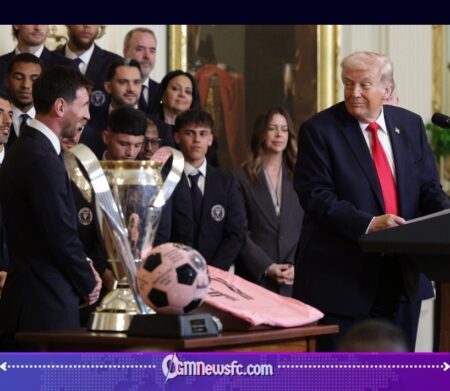
Infantino also defended FIFA’s decision to award Donald Trump the inaugural FIFA peace prize during the World Cup draw held in Washington. The move had attracted widespread criticism, particularly following controversial foreign policy actions linked to the former US president.
Despite the backlash, Infantino maintained that Trump objectively deserved the award, citing his involvement in facilitating a ceasefire between Israel and Hamas. He argued that FIFA’s assessment was based on the impact of actions taken to reduce conflict and save lives, rather than broader political controversies.
Russia’s Possible Return to International Football
Another key issue addressed by Infantino was the ongoing ban on Russian teams from international football, imposed following Russia’s invasion of Ukraine in 2022. He said FIFA and UEFA would have to consider Russia’s readmission, particularly at youth levels.
Infantino argued that the ban had failed to achieve meaningful outcomes and had instead fuelled frustration and division. He suggested that allowing Russian children to participate in international football could promote understanding and reduce hostility across borders.
World Cup Boycott Concerns and FIFA’s Position
Infantino dismissed suggestions that this summer’s World Cup could face a boycott due to domestic and foreign policies associated with the Trump administration. Concerns had been raised following unrest in several US cities and controversial statements regarding Greenland.
He questioned why football should be singled out when businesses rarely boycott countries over political disagreements. According to Infantino, football remains a vital platform for dialogue, unity, and shared passion in an increasingly fragmented world.