









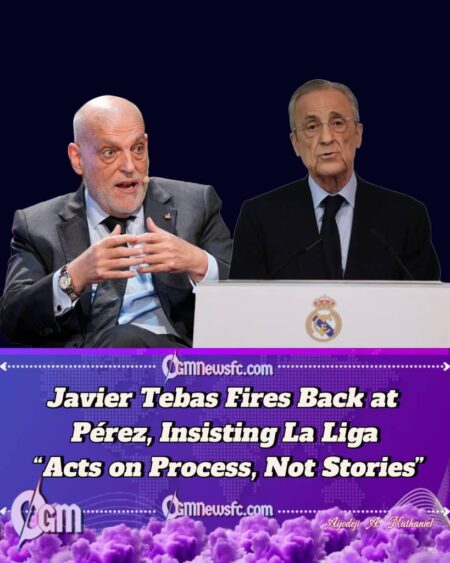
Javier Tebas has issued a pointed response to remarks made by Florentino Pérez, firmly rejecting suggestions that Spanish football’s governing structures are driven by narratives rather than due process. Tebas’ statement—“La Liga respects the processes, acts when it must and does not build stories”—was both a defense of institutional integrity and a direct counter to Pérez’s latest critique.
The response signals an escalation in an already strained relationship between La Liga’s leadership and one of its most powerful clubs. While Tebas avoided naming Pérez explicitly in his opening remarks, the context was unmistakable, reflecting deep-rooted tensions over governance, authority, and the future direction of Spanish football.
Pérez’s Speech and the Subtext of Accusation
Pérez’s recent address reignited long-standing grievances, framing La Liga as an organization prone to selective enforcement and narrative-building that disadvantages certain clubs—particularly Real Madrid. Though couched in measured language, the speech carried a clear implication: that structural bias and political maneuvering, rather than transparent regulation, shape key decisions.
This framing has resonated with sections of Madrid’s support base but has also drawn criticism for undermining confidence in domestic competition. Observers note that Pérez’s rhetoric fits a broader strategy of challenging centralized authority, consistent with his outspoken stance on governance reform and breakaway competitions.
Tebas Defends Process and Institutional Credibility
Tebas’ rebuttal focused squarely on procedure. By emphasizing that La Liga “acts when it must,” he sought to reinforce the idea that regulatory interventions are rule-based rather than reactive to pressure or public sentiment. The insistence on not “building stories” was a clear rejection of claims that the league operates through media influence or agenda-setting.
For Tebas, the issue extends beyond a personal dispute. His defense was aimed at safeguarding La Liga’s credibility with broadcasters, sponsors, and international partners, all of whom depend on the perception of fairness and predictability within Spain’s top flight.
A Long-Running Power Struggle Comes Back Into Focus
The exchange is the latest chapter in a protracted power struggle between La Liga’s central authority and elite clubs seeking greater autonomy. Disagreements over financial controls, revenue distribution, and strategic projects have repeatedly placed Tebas and Pérez on opposing sides.
Analysts argue that this public sparring reflects competing visions of football governance: Tebas advocating for collective regulation and competitive balance, Pérez pushing for club-driven influence and global expansion. Each confrontation sharpens these ideological lines, making compromise increasingly difficult.
Implications for Spanish Football’s Near Future
Beyond the personalities involved, the dispute raises questions about unity within Spanish football at a time of intense global competition. Public clashes between league officials and club presidents risk projecting instability, potentially weakening La Liga’s negotiating position internationally.
For now, Tebas’ message is clear: the league will not concede ground on its processes or legitimacy. Whether Pérez escalates the rhetoric further—or opts for a quieter, strategic response—will determine whether this confrontation cools or hardens into another defining fault line in Spanish football governance.