

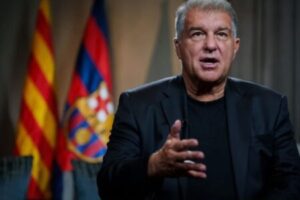






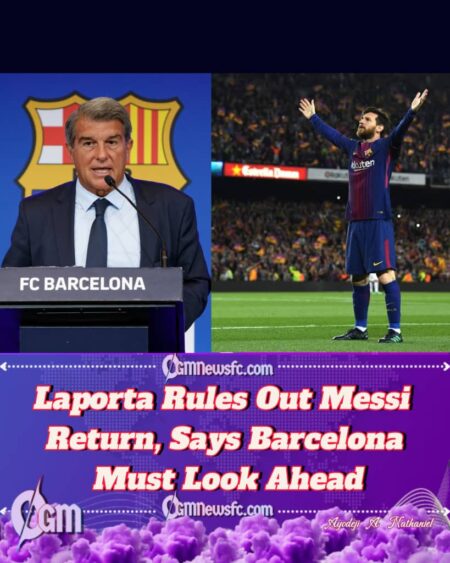
Barcelona president Joan Laporta has officially shut down any remaining speculation about a potential return of club icon Lionel Messi. Speaking during a media engagement, Laporta made it clear that despite fans’ emotional attachment to the idea, a comeback as a player is “just not realistic.” His statement brings clarity to months of whispers and fan-driven optimism surrounding the possibility of Messi once again wearing the Barcelona colors.
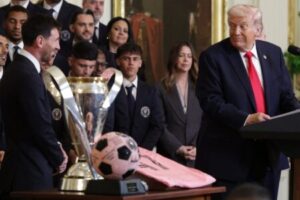
Laporta emphasized that Messi, who joined Inter Miami in 2023, remains fully committed to his contract with the MLS club. With commercial obligations, sporting agreements, and project commitments tied to his presence in the United States, the president noted that such a move is simply beyond consideration at this time. His remarks serve as the clearest indication yet that the door to Messi’s playing career in Barcelona is effectively closed.
The president added that while the club treasures its history with Messi, decisions must reflect current realities rather than emotional desires. His message targeted supporters who have been hoping for one final chapter between the Argentine legend and the Catalan giants.
Inter Miami Contract Makes Return Impossible
Laporta reiterated that Messi’s active contract with Inter Miami is one of the primary barriers to any potential return. The MLS club has positioned Messi at the center of its long-term sporting and commercial strategy, making a release or transfer highly unlikely. With Messi’s influence driving unprecedented ticket sales, global visibility, and sponsorship deals, Inter Miami views him as the heartbeat of its project.
Messi’s move to the United States has also been accompanied by off-field commitments, including brand partnerships, academy collaborations, and strategic projects that stretch beyond his playing years. These factors, Laporta noted, are deeply embedded in Messi’s ongoing role at the club and cannot simply be undone.
Barcelona, already navigating financial restrictions imposed by La Liga, would struggle to accommodate the economic requirements that a Messi return would demand. Laporta’s comments underscore both contractual and financial roadblocks that make such a reunion more of a dream than possibility.
Barcelona Shifts Focus to Long-Term Project
According to Laporta, the club’s leadership is now focused on constructing a sustainable football project built for the present and future. The president stressed that Barcelona’s next era requires investment in youth development, tactical evolution, and infrastructure upgrades, rather than sentimentality. He remarked that clinging to the past could hinder progress, stating plainly, “If you live in the past, you hardly move forward.”
Barcelona continues to prioritize its La Masia pipeline, emerging talents, and a system designed to maximize competitive stability. With the team undergoing transitions in leadership and identity, Laporta believes the club must consolidate its foundation rather than revisit eras that have already passed.
The focus, he said, is not to recreate the Messi era but to build a new identity capable of competing at the highest level. This includes maintaining financial discipline, strengthening the squad strategically, and preparing for long-term competitiveness both domestically and in Europe.
Emotional Disconnect Between Fans and Club Reality
For many supporters, Laporta’s remarks might feel like a definitive end to a cherished dream. Messi’s departure in 2021 left deep emotional wounds, and fans have long fantasized about a proper farewell or final season at Camp Nou. The president acknowledged this sentiment but insisted that the club cannot be guided by emotion alone.
Barcelona’s leadership faces the challenging task of balancing nostalgia with realism. Messi’s legacy remains unmatched, and his connection to Barcelona is deeply woven into the club’s identity. However, Laporta emphasized that decisions must prioritize stability, competitiveness, and forward movement rather than emotional narratives.
Critics argue that Barcelona has struggled to fully replace Messi’s sporting impact, but Laporta maintains that the team’s future lies in collective strength rather than relying on one individual. He urged supporters to trust the club’s direction and embrace the new generation of talent emerging in Catalonia.
A New Chapter for Club and Legend
While Messi’s return as a player has been ruled out, Laporta hinted that the door remains open for future collaboration in non-playing roles. From ambassadorial duties to potential sporting or institutional involvement, the club is expected to explore ways to honor and integrate Messi’s legacy in a manner compatible with current realities.
Laporta emphasized the importance of creating a Barcelona that both respects its past and prepares for its future. Messi, widely regarded as the greatest player in the club’s history, will always have a place in Barcelona’s heritage, but the club must evolve independently. “The future of Barça cannot be built by holding onto history alone,” he reiterated.
For now, Messi’s chapter as a player at Barcelona appears firmly closed, marking the start of a new timeline for both the Argentine star and the club he defined for over two decades. The focus now shifts to growth, development, and the next generation tasked with carrying the Barcelona identity forward