










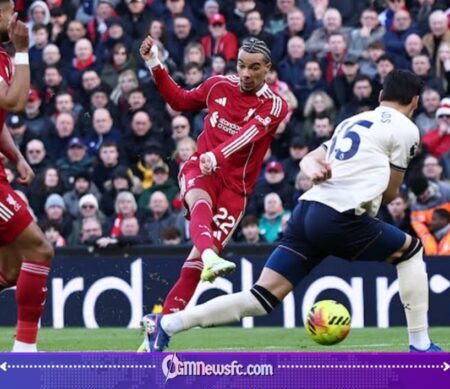
Liverpool delivered a commanding five-goal performance at Anfield to deepen West Ham United’s relegation worries, underlining the widening gulf between the two clubs both on and off the pitch. The victory not only strengthened Liverpool’s push for UEFA Champions League qualification but also exposed West Ham’s defensive frailties, particularly at set pieces.
The contrast between the sides was evident beyond the scoreline. While Liverpool recently announced record revenues of £703 million in their latest financial accounts, West Ham disclosed a £104.2 million loss for the same period and signalled the likelihood of player sales this summer. The financial divergence mirrored the gulf in execution, organisation and confidence displayed during a decisive afternoon on Merseyside.
Liverpool First-Half Domination Reflects Growing Set-Piece Prowess
The contest was effectively settled before half-time as Liverpool struck three times, all stemming from corner kicks. The opener arrived when Hugo Ekitiké reacted sharply after West Ham failed to clear their lines. His early effort, aided by a slight deflection off Konstantinos Mavropanos, beat goalkeeper Mads Hermansen and set the tone for the afternoon.
Liverpool’s second came through captain Virgil van Dijk, who rose powerfully to meet Dominik Szoboszlai’s delivery. The Dutch defender shrugged off his marker and guided a firm header into the net, reinforcing his growing influence in attacking set-piece situations.
The third goal was the most technically impressive. Mohamed Salah’s corner was flicked on by Van Dijk, cushioned by Ekitiké and finished superbly by Alexis Mac Allister, whose volley found the roof of the net without the ball touching the ground. The move epitomised Liverpool’s renewed efficiency from dead-ball situations — a marked transformation after earlier-season struggles that led to changes in their set-piece coaching setup.
West Ham’s Resistance and Missed Opportunities
Despite trailing heavily, West Ham showed flashes of attacking intent. Mateus Fernandes and Crysencio Summerville were particularly lively, testing Liverpool’s defensive shape with pace and movement. However, clear-cut finishing proved elusive during their best spells of possession.
Tomas Soucek provided a lifeline early in the second half, sliding in to convert El Hadji Malick Diouf’s low cross. Later, Taty Castellanos capitalised on a well-delivered Jarrod Bowen corner to head home unmarked at the back post, briefly reigniting hope among the visiting supporters.
Goalkeeper Alisson Becker was called into action at key moments, producing saves from Soucek and Bowen to maintain Liverpool’s cushion. Yet each West Ham surge was met with a clinical response from the hosts, who never appeared in serious danger of surrendering control.
Gakpo’s Response and Disasi’s Misfortune Seal the Outcome
Any lingering anxiety inside Anfield was eased when Cody Gakpo restored Liverpool’s three-goal advantage. His low effort struck Aaron Wan-Bissaka and deflected into the far corner, typifying the fortune that often accompanies dominant sides.
West Ham continued to compete, but defensive vulnerabilities resurfaced late on. Substitute Jeremie Frimpong delivered a low cross that deflected off Axel Disasi and into his own net, compounding the visitors’ misery and completing a comprehensive five-star display.
The chants from the home support reflected growing concern for West Ham’s top-flight status. With financial pressures mounting and survival hopes fading, the London club faces a defining period in the weeks ahead.
Financial Realities Mirror On-Field Contrasts
Beyond the action, the match highlighted stark structural differences. Liverpool’s financial strength, evidenced by record revenues, has allowed sustained squad investment and stability. Under manager Arne Slot, the team has evolved into one of the league’s most organised and efficient units, particularly from set plays.
In contrast, West Ham’s reported losses and anticipated summer sales underscore deeper uncertainty. Even with moments of attacking promise, defensive lapses and inconsistency have left them precariously positioned near the relegation zone.
As the season approaches its climax, Liverpool look increasingly assured in their pursuit of Champions League qualification, while West Ham confront the prospect of rebuilding amid significant financial constraint.