










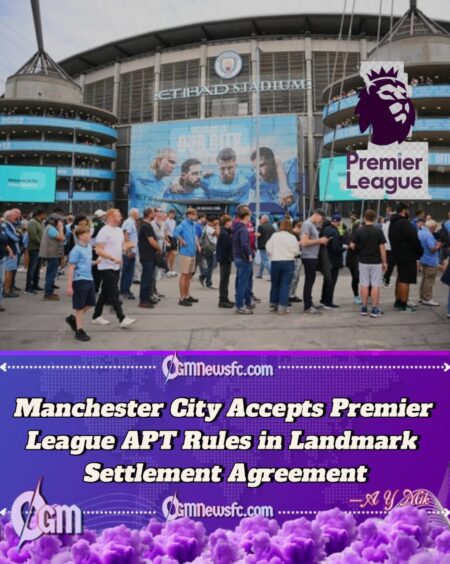
Manchester City and the Premier League have agreed to a settlement regarding the controversial Associated Party Transaction (APT) Rules,In a dramatic twist to one of English football’s ongoing legal battles.The agreement brings an end to months of arbitration, with City now officially accepting the rules as “valid and binding.”
Settlement Ends Long-Running Manchester City APT Rules Dispute
On Monday afternoon, Manchester City released a statement confirming that both the club and the Premier League had reached common ground over the APT case. The announcement revealed that the proceedings have been terminated, closing a chapter that has dragged on since early 2024.
According to the statement, City now recognizes the Premier League APT Rules as legally enforceable. The club further confirmed that no further comments would be made by either party. For fans and analysts, the announcement signals a rare moment of compromise between a club often at odds with the governing body.
This agreement comes just months before a scheduled hearing in 2025, which has now been shelved. With the case dropped, attention turns to how the settlement will affect City’s future sponsorship dealings.
Why Manchester City Challenged the Premier League APT Rules
The Manchester City APT Rules dispute began when the Premier League introduced tighter regulations to monitor sponsorship deals linked to club ownership. Designed to prevent inflated sponsorship values from boosting financial fair play compliance, the rules were seen as a direct curb on state-backed clubs like City.
City had previously attempted to sign lucrative sponsorship agreements with Etihad Airways and First Abu Dhabi Bank in 2023. However, the Premier League blocked these deals, ruling them as not being fair-market value under APT regulations. City argued that such restrictions were anti-competitive and unlawful, prompting their lawyers to challenge the Premier League in court.
In October 2024, a tribunal partially sided with City, declaring three elements of the APT rules unlawful. However, even after the Premier League rewrote the rules, City continued to push for further changes, maintaining that they still breached principles of public law.
How the APT Rules Work and Why They Matter
The Associated Party Transaction rules were introduced to safeguard the integrity of English football’s financial ecosystem. Under these rules, clubs must prove that sponsorship deals with companies connected to their ownership structures are priced at fair-market value.
Without such oversight, clubs could theoretically inflate revenues by signing excessively lucrative contracts with friendly organizations, thus gaining an unfair advantage in the transfer market. For instance, a deal with a company owned by the same group as the football club could be artificially set at a higher value, boosting spending power while staying within financial fair play limits.
For Manchester City, backed by the Abu Dhabi United Group, the rules were seen as an obstacle to maximizing commercial revenue streams. The dispute with the Premier League was therefore not just about one sponsorship deal—it was about the broader financial framework shaping the modern game.
Impact of the Settlement on Manchester City’s Sponsorships
With the Manchester City APT Rules settlement finalized, the focus now shifts to what this means for the club’s commercial future. The acceptance of the current rules means City must continue to seek independent valuations for any deals linked to ownership entities, including Etihad Airways.
However, the February 2025 ruling, which voided the old rules, opened the door for City’s previously blocked sponsorship agreements to potentially move forward under the revised regulations. These deals, agreed nearly two years ago, could now pass the fair-market value test, injecting fresh revenue into the club’s coffers.
For City’s executives, this settlement may be less of a defeat and more of a strategic compromise. By ending the legal battle, the club avoids further scrutiny while ensuring its existing commercial strategies can still thrive within the updated framework.
The Bigger Picture: Financial Charges Still Loom Over Manchester City
It is important to note that this APT settlement is separate from the ongoing investigation into 130 financial charges levied against Manchester City by the Premier League. These charges relate to alleged breaches of financial regulations spanning nearly a decade.
City has firmly denied all wrongdoing and is preparing to defend itself in what could be one of the most significant legal battles in Premier League history. The settlement over the APT Rules does not affect that case, but it does show City’s willingness to resolve disputes when it serves their strategic interests.
For now, the club remains under heavy scrutiny both on and off the pitch. While Pep Guardiola focuses on winning titles, the boardroom continues to wrestle with legal challenges that could shape the future of the club and potentially the entire league.
What This Means for the Future of Financial Fair Play in the Premier League
The resolution of the Manchester City APT Rules case sets a precedent for how future disputes between clubs and the Premier League may unfold. By securing City’s acceptance of the rules, the Premier League has strengthened its authority to regulate sponsorship deals, especially in an era of increasing state-backed ownership.
At the same time, City’s ability to negotiate better terms under the revised rules shows that clubs can still influence financial frameworks through legal pressure. The settlement may not be the end of financial disputes in English football, but it demonstrates that compromise is possible.
Looking ahead, the spotlight will remain firmly on how these rules are enforced, how clubs adapt, and whether Manchester City’s sponsorship model continues to thrive despite restrictions. For fans, the outcome is a reminder that football is not just decided on the pitch—it is also shaped by battles in the courtroom and the boardroom.