









Manchester City remain the Premier League’s biggest spenders on player wages despite embarking on an aggressive long-term strategy to rein in costs, newly published financial reports have revealed. While the club’s wage bill has begun to fall, Manchester City continue to sit comfortably above their domestic rivals as Pep Guardiola oversees a major squad transition designed to future-proof the champions.
The latest accounts underline a delicate balancing act at the Etihad Stadium: sustaining elite performance levels while gradually reshaping the squad profile, reducing reliance on ageing stars, and preparing for a more sustainable financial structure. Although Manchester City’s spending power remains formidable, the figures suggest a clear shift in philosophy following years of unprecedented success.
Premier League’s Highest Wage Bill — Manchester City For Now
According to financial statements released on Tuesday, Manchester City recorded a total wage bill of £408 million for the year ending June 30. While this figure represents a modest reduction from last year’s £412 million, it still stands as the highest in the Premier League, ahead of Liverpool, Chelsea, Arsenal and Manchester United.
The accounts reflect a downward trend from the £423 million wage spend recorded two years ago, during the historic Treble-winning season. That peak coincided with a squad stacked with elite, experienced performers operating at the height of Guardiola’s tactical dominance.
However, the figures do not yet tell the full story. Several high-profile departures occurred after the reporting period, meaning the most significant savings will only be fully reflected in the club’s next set of accounts.
Veteran Departures Signal End of an Era
City’s transitional phase has been marked by the exit of several senior figures, including Kevin De Bruyne, widely regarded as the greatest player in the club’s modern history. The Belgian’s departure symbolised a decisive break from an era defined by established superstars and relentless domestic dominance.
Alongside De Bruyne, goalkeeper Ederson moved to Fenerbahce, Ilkay Gundogan joined Galatasaray, and club captain Kyle Walker departed for Burnley. Jack Grealish and Manuel Akanji also left on loan to Everton and Inter respectively, with both expected to complete permanent transfers next summer.
Collectively, those five players accounted for an estimated £50 million per year in basic wages. By the time the 2026 accounts are published, Manchester City expect those costs to be entirely wiped from the payroll, delivering a substantial reduction in annual expenditure.
Youth-Focused Recruitment and Haaland’s Contract Outlier
The financial shift has been accompanied by a change in recruitment strategy. New arrivals such as Rayan Cherki, Tijjani Reijnders, Omar Marmoush and Nico Gonzalez have been brought in on comparatively controlled wage packages, helping to offset the loss of veteran stars while maintaining squad depth and technical quality.
Erling Haaland, however, remains the clear exception. The Norwegian striker signed a sensational new nine-year contract in January, with wages that dwarf those of most teammates. While his earnings inflate the overall wage total, Manchester City view Haaland as a generational asset whose value transcends standard financial logic.
Notably, the wages of summer signings James Trafford and Gianluigi Donnarumma are not included in the latest accounts, as both arrived after the June 30 cut-off. The two goalkeepers are estimated to earn around £15 million per year between them, a figure that will appear in future financial statements.
Financial Resilience Amid Squad and Staff Expansion
Despite the reduction in player wages, Manchester City’s overall operational footprint continues to grow. The club hired 59 additional staff across football and commercial departments during the reporting period, reflecting ongoing expansion behind the scenes and increased demands from global commercial operations.
Chairman Khaldoon Al Mubarak described the past year as a defining moment in City’s evolution. “I believe that we may look back on this year as one that was pivotal for the ongoing and long-term strengthening of the club,” he said, emphasising a commitment to continuous improvement on and off the pitch.
Financially, Manchester City reported revenues of £694 million alongside a loss of £9.9 million. While the deficit is relatively modest by elite European standards, it highlights the cost of sustaining excellence while investing heavily in infrastructure, personnel, and squad renewal.
Rivals Close the Gap as Infrastructure Grows
Manchester City’s wage dominance is no longer as overwhelming as in previous seasons. Liverpool’s latest wage bill stood at £386 million in 2024, while Chelsea, Arsenal and Manchester United have all surpassed the £300 million mark. Both Arsenal and Liverpool are expected to see further increases as they strengthen squads to compete at the top.
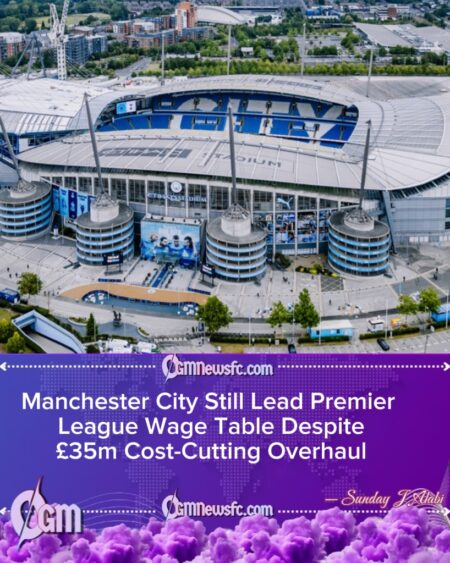
Beyond the pitch, Manchester City confirmed that the expanded North Stand at the Etihad Stadium remains on schedule to open before the end of the season. The development forms part of a broader strategy to boost matchday revenue and enhance long-term commercial sustainability.
Taken together, the figures paint a picture of a club carefully recalibrating its financial model without relinquishing its competitive edge. Manchester City may still top the Premier League wage table, but the direction of travel suggests a future built less on lavish spending — and more on strategic evolution.