







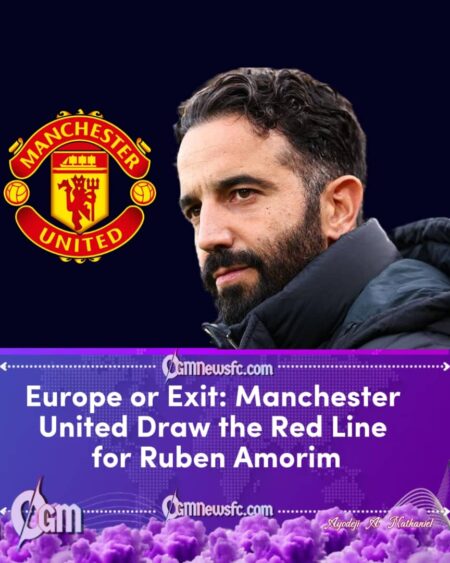
Manchester United begin this season with a rare sense of lowered ambition but heightened urgency. European qualification has been set internally as the minimum acceptable outcome, a target that speaks volumes about the club’s current reality. At Old Trafford, finishing in Europe is no longer framed as success — it is framed as survival.
This recalibration has placed significant pressure on head coach Rúben Amorim. While the Portuguese tactician was appointed with long-term rebuilding in mind, the short-term demands of elite football remain unforgiving. Fail to reach Europe, and Amorim’s future is expected to come under serious review.
Manchester United and the New Definition of Progress
For decades, Manchester United measured progress in trophies and title challenges. This season, however, progress has been redefined in more modest terms: securing a place in European competition. It is a shift driven by realism rather than nostalgia.
Club executives view European football as essential to maintaining revenue, commercial leverage, and recruitment power. Without it, United risk falling further behind domestic and continental rivals — a scenario the hierarchy considers unacceptable, regardless of rebuilding narratives.
Amorim’s Project Meets Old Trafford Reality
Ruben Amorim arrived with a reputation for tactical clarity, discipline, and long-term squad development. His footballing philosophy emphasizes structure over chaos — an idea warmly received after years of instability.
Yet Manchester United remain a club where time is rationed carefully. While Amorim has not been handed a public ultimatum, reports suggest his position is closely tied to league placement. The message is subtle but firm: vision is welcome, but results are mandatory.
INEOS, Metrics, and a Sharper Lens
Under the influence of INEOS, decision-making at Old Manchester United has taken a more corporate tone. Performance is increasingly judged through measurable outcomes rather than emotional attachment or reputational patience.
European qualification has become the key metric. It justifies spending, validates strategy, and reassures stakeholders. For Amorim, this means that style points, development arcs, and “promising signs” carry less weight if the table does not cooperate.
Manchester United’s Inconsistency Problem
Manchester United’s season has been defined by unpredictability. One week brings tactical discipline and belief; the next delivers dropped points and familiar frustration. Injuries and squad imbalances have offered explanations, though not excuses.
This inconsistency has fueled speculation around Amorim’s future. At a club where context rarely softens judgment, each disappointing result is magnified — sometimes before the final whistle has even cooled.
Public Backing, Private Calculations
Officially, the club maintains a stance of calm support for Amorim. Public messaging emphasizes stability, patience, and trust in the process. Privately, however, contingency planning is understood to be standard practice at elite clubs.
This duality leaves Amorim navigating familiar managerial territory: backed, but watched; trusted, but timed. It is not hostility — it is modern football realism.
Why Europe Matters More Than Pride
European qualification affects far more than bragging rights. It shapes transfer budgets, influences elite players’ decisions, and stabilizes long-term planning. Missing out would not merely sting — it would restructure the club’s entire summer strategy.
For Amorim, Europe represents validation of his methods. For Manchester United, it represents relevance. Their interests align neatly, but only if the final league position cooperates.
A Defining Stretch Ahead
As the season enters its decisive phase, the equation is simple. Deliver Europe, and Amorim strengthens his grip on the project. Fail, and Old Trafford’s familiar cycle of reassessment may resume.
Manchester United have drawn their line clearly. Whether it becomes a foundation or a fault line now depends on results — not rhetoric.