




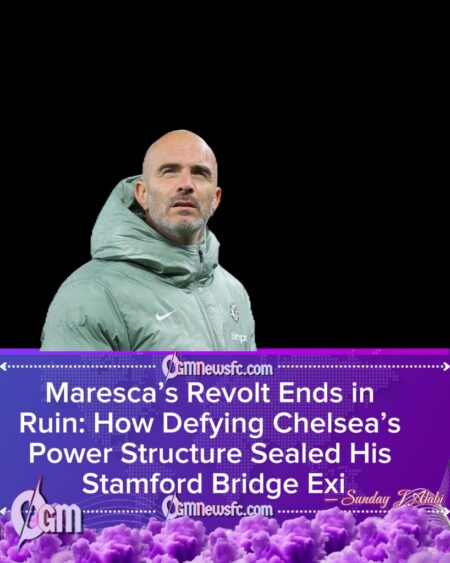
Chelsea’s long-running truth was once again laid bare on New Year’s Eve: at Stamford Bridge, the manager does not call the shots. Enzo Maresca’s dismissal, confirmed barely a day into 2026, was not a sudden explosion but the inevitable conclusion of months of tension, mixed messages, and an increasingly open challenge to the club’s power structure. What began as quiet frustration ended in a public standoff that Chelsea’s hierarchy had little choice but to end decisively.
A New Year’s Eve Breaking Point at Stamford Bridge
Chelsea’s patience finally snapped late on New Year’s Eve, when club executives became convinced that Enzo Maresca was actively engineering his own exit. Midnight approached, fireworks loomed, and behind closed doors Stamford Bridge braced for another managerial rupture. By the time the calendar turned, Maresca had already dared the club to act.
The immediate flashpoint came after Tuesday night’s underwhelming 2–2 draw with Bournemouth. Maresca declined to conduct his post-match press conference, with the official line citing illness. The explanation rang hollow. He had spent the evening animated on the touchline, and within hours reports emerged that the illness claim was a smokescreen. In reality, Maresca had chosen silence because he wanted “time to consider his options”.
To Chelsea’s hierarchy, this was confirmation of what they already suspected: their head coach wanted to be sacked. At a club that prizes control and clarity, the refusal to face the media was viewed as a direct challenge. Less than 24 hours later, Maresca was unemployed, his rebellion decisively shut down.
Maresca:From Subtle Discontent to Open Rebellion
The end had been approaching since Maresca’s cryptic comments after last month’s routine win over Everton, when he spoke of enduring his “worst 48 hours” at the club. Chelsea officials despised the volatility of such remarks, particularly from a manager still early in his career. After the 2–2 draw with Newcastle on 20 December, one source warned that Maresca’s position would become untenable if he continued to act out publicly.
Maresca’s behaviour betrayed inexperience as much as frustration. This was not peak José Mourinho or Thomas Tuchel confronting the board from a position of dominance. Maresca, just three years into management, was still learning how power operates at an elite club. His badge-thumping declarations of love for Chelsea fans after beating Cardiff City raised eyebrows internally, seen more as theatre than substance.
Sources also claim Maresca attempted to use interest from Juventus and Manchester City as leverage for an improved contract. That brazenness infuriated Chelsea’s leadership. In their eyes, ambition was welcome, but posturing and pressure tactics were not.
Results Dip and Doubts Grow on the Pitch
On the pitch, Chelsea’s form offered little protection. After being talked up as title contenders in late November, the team slid into a damaging run of one win in seven league matches. Tactical concerns mounted as Chelsea dropped 20 points from winning positions across all competitions, an alarming statistic that undermined confidence in Maresca’s game management.
Fans also struggled to embrace his cautious, positional approach. While Chelsea could be exhilaratingly direct against elite opponents, they often looked ponderous against deep defences. Home draws and dropped points against Brighton, Bournemouth, Crystal Palace and Sunderland fuelled discontent, while last season’s failure to beat Ipswich still lingered as an uncomfortable memory.
Yet Maresca’s tenure was not without achievement. After replacing Mauricio Pochettino in the summer of 2024, he guided Chelsea back into the Champions League and capped his first season with Conference League and Club World Cup triumphs. He departs with the club fifth in the league and still alive in the FA Cup and Carabao Cup. The issue, for Chelsea, was not only results but the direction of travel and the tone set by their head coach.
Power, Recruitment and the Limits of Managerial Authority
Cracks widened when Maresca reacted to Levi Colwill’s pre-season knee injury by demanding a new centre-back. That demand struck at the heart of Chelsea’s operating model. Since the takeover by Todd Boehly and Clearlake Capital, recruitment has been driven by a centralised structure focused on young players tied to long-term contracts.
Chelsea trust their recruitment group — Paul Winstanley, Laurence Stewart, Dave Fallows, Joe Shields and Sam Jewell — with Behdad Eghbali a dominant strategic voice. This is not a club where managers dictate transfer policy, and Maresca’s frustration with that reality was never going to be indulged.
Maresca believed there was excessive interference from above, particularly regarding load management advice from the medical department. Chelsea strongly deny ever dictating tactics or sidelining him from recruitment decisions. What they did insist upon was rotation, scarred by the injury crisis under Pochettino in 2023–24. With fragile players such as Reece James, Pedro Neto and Wesley Fofana, the club prioritised availability over sentiment.
Rotation, Confidence and the Guardiola Shadow
Rotation became a central battleground. Maresca argued that his best players struggled with congestion, pointing to Cole Palmer’s groin issue and midfield injuries to Roméo Lavia and Dário Essugo. Critics questioned his changes after defeats to Leeds and Atalanta, while supporters booed when he substituted a tiring Palmer against Bournemouth.
Chelsea, however, remained broadly supportive of rotation. Their concern arose only when key players were overused, such as James playing three full matches in a single week. Internally, frustration grew when Maresca publicly questioned the readiness of squad players like Andrey Santos or highlighted the team’s lack of experience. To the hierarchy, this amounted to undermining a squad they believed in.
The final straw came with Manchester City. Chelsea were deeply unhappy with Maresca being touted as a potential successor to Pep Guardiola. It has since emerged that he informed the club he had spoken to people connected to City about replacing Guardiola on three occasions this season. In that context, his actions took on a different meaning, and the pieces fell into place.
A Familiar Chelsea Ending
Chelsea now head to Manchester City on Sunday without Maresca, likely turning to Strasbourg manager Liam Rosenior, from their partner club, as an interim solution. In the inevitable PR battle, Maresca’s defenders will argue that Pochettino, Thomas Tuchel and Graham Potter all struggled within Chelsea’s post-takeover structure.
Yet Maresca toed the line until it suited him not to. He arrived fresh from leading Leicester City to the Championship title, and he leaves with his reputation enhanced but his Chelsea chapter closed. Seen by some as a “mini Guardiola”, he is betting that his stock is high enough to capitalise elsewhere.
Chelsea, for their part, have no regrets. At Stamford Bridge, the hierarchy sets the course. Managers ignore that golden rule at their peril — and Enzo Maresca is simply the latest to learn it the hard way