










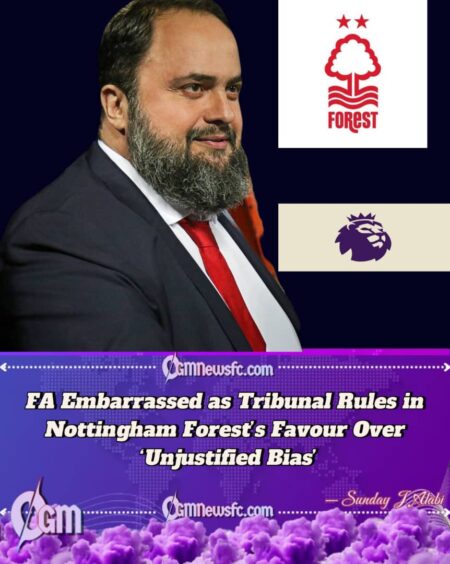
Nottingham Forest have secured a significant legal victory over the Football Association (FA) after a tribunal ruled that the governing body’s disciplinary process had been tainted by “apparent bias.” The case, which centered on a dispute involving fines and disciplinary procedures, has resulted in Nottingham Forest being awarded more than £100,000 in compensation and legal costs.
The dispute stemmed from two separate incidents in 2024. First, Nottingham Forest were hit with a £750,000 fine—initially proposed at £1 million—for a strongly worded social media post accusing a VAR official of being a Luton Town supporter, which the club argued compromised the integrity of a Premier League clash against Everton. Then, in a separate case, the club was fined £125,000 for a mass brawl against Chelsea at Stamford Bridge.
Nottingham Forest appealed both fines, but their legal challenge focused on the role of Graeme McPherson KC, the chair of the FA’s disciplinary panel, who had previously described the club’s submissions as “somewhat hysterical.” The tribunal has now ruled that such remarks created an impression of bias that undermined the fairness of the process.
The VAR Controversy and Social Media Fallout
The saga began in April 2024 when Nottingham Forest publicly criticised match officials following their 2-0 defeat to Everton. In a post that drew more than 40 million views, the club claimed they had been denied three penalties and alleged a conflict of interest involving the Video Assistant Referee.
“Three extremely poor decisions—three penalties not given—which we simply cannot accept,” the tweet read. “We warned the PGMOL that the VAR is a Luton fan before the game but they didn’t change him. Our patience has been tested multiple times. NFFC will now consider its options.”
The FA charged the club with bringing the game into disrepute, seeking a record £1 million fine before settling at £750,000. Nottingham Forest maintained that the penalty was excessive and argued that the FA’s handling of the case was unjustified. McPherson’s dismissal of their defence as “hysterical” became a key flashpoint in the subsequent legal battle.
Chelsea Brawl and Appeal Process Dispute
In a separate incident at Stamford Bridge, Forest players were involved in a heated confrontation with Chelsea during a Premier League fixture. The FA imposed a £125,000 fine, which the club appealed. However, the controversy deepened when McPherson was again selected to oversee the appeal process despite his earlier remarks.
Nottingham Forest protested that his involvement created a clear conflict of interest, citing his prior dismissal of their arguments in the Everton case. McPherson eventually recused himself, citing “pre-existing commitments,” but the tribunal determined that his initial inclusion was itself problematic.
The tribunal’s written ruling emphasised that his comments “would be seen by the notional fair-minded independent observer to be an unjustified, inappropriate, and personal attack on the club and its legal representatives.” The conclusion was unequivocal: McPherson suffered from apparent bias and should not have been involved in Forest’s disciplinary proceedings.
Financial Consequences for the FA
The ruling has not only cleared Nottingham Forest’s name in relation to the claims of bias but has also left the FA with a sizeable financial burden. The governing body has been ordered to pay £105,750 plus VAT to cover the cost of the tribunal and Forest’s legal expenses.
This payout comes on top of the reputational damage sustained by the FA, which has faced mounting criticism over its disciplinary structures. The decision highlights the importance of perceived impartiality in regulatory processes and sets a precedent that could affect future disputes involving clubs and the governing body.
For Nottingham Forest, the financial settlement represents a six-figure windfall, but perhaps more importantly, it is a moral victory in their long-running battle with the FA. The outcome also provides fresh ammunition for other clubs that have felt unfairly treated by disciplinary rulings.
What This Means for Nottingham Forest and English Football
The verdict marks a turning point for Nottingham Forest, who had consistently maintained that they were unfairly targeted by the FA. By successfully challenging the process on grounds of bias, the club has forced the governing body to review its procedures for appointing panel chairs and handling appeals.
For the wider football community, the case underscores the need for transparency and accountability in disciplinary proceedings. It also raises questions about whether other clubs might seek similar redress when they believe they have been treated unjustly.
With the FA now under pressure to rebuild trust, Nottingham Forest will view this victory not just as financial compensation, but as a vindication of their fight for fairness. The ruling may yet spark broader reforms in how English football’s authorities deal with conflicts of interest and disciplinary integrity.