








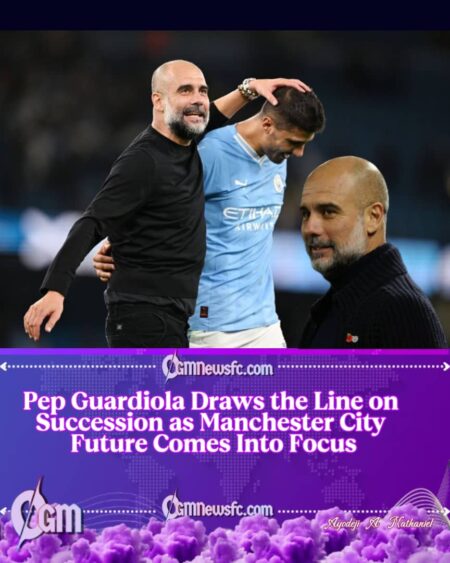
Pep Guardiola has offered rare clarity on one of football’s most sensitive topics: succession. Speaking candidly, the Manchester City manager stated unequivocally that he will not be involved in choosing the club’s next head coach when his tenure eventually comes to an end.
Guardiola emphasized that managerial transitions are not governed by personalities but by performance. “At the end, always results decide the end of the chapter,” he said, underlining the unforgiving reality of elite football and distancing himself from any suggestion of influence over his successor.
Results, Not Relationships, Decide the End
Central to Guardiola’s comments were the primacy of results. He framed managerial tenures as chapters that close naturally when outcomes no longer align with expectations, regardless of past achievements or personal standing within the club.
This perspective reflects Guardiola’s long-held professional ethos. Success earns time, but nothing more. Once results falter, sentiment becomes irrelevant, and institutional decision-making takes precedence. His remarks serve as both realism and warning in a sport often driven by emotion and legacy.
Manchester City’s Institutional Authority
By stressing that “the club will choose the best one,” Guardiola reaffirmed Manchester City’s authority and governance structure. The message was clear: succession planning belongs to the institution, not the individual currently occupying the role.
This stance reinforces City’s reputation as a club built on systems rather than personalities. From recruitment to long-term strategy, decision-making is centralized, data-driven, and insulated from personal influence—even that of the most successful manager in the club’s history.
Avoiding the Shadow of Legacy
Guardiola’s refusal to shape the next managerial appointment can also be read as a deliberate effort to avoid casting a long shadow over his successor. Managers who handpick replacements often create implicit comparisons that complicate transitions.
By stepping away entirely, Guardiola allows the next coach to arrive without inherited expectations or perceived allegiance. It is a clean break philosophy—one designed to protect both the club’s future stability and the incoming manager’s autonomy.
A Signal to the Dressing Room and Supporters
The comments also carry internal significance. For players and staff, Guardiola’s words reinforce a culture where no position is permanent and performance remains the ultimate currency. Authority flows from results, not reputation.
For supporters, the statement may temper speculation and anxiety. Rather than hinting at imminent departure, Guardiola framed the issue as procedural rather than personal—an acknowledgment of football’s natural cycle rather than a signal of immediate change.
What It Means for City’s Long-Term Planning
Guardiola’s remarks inevitably reopen discussion about Manchester City’s long-term future, but they also project calm rather than uncertainty. The club, he suggested, is equipped to manage transitions with the same discipline that has underpinned its sustained success.
In refusing to anoint a successor, Guardiola underscored a defining truth of modern football governance: managers may shape eras, but institutions endure. When the time comes, Manchester City—not Pep Guardiola—will write the next chapter.