









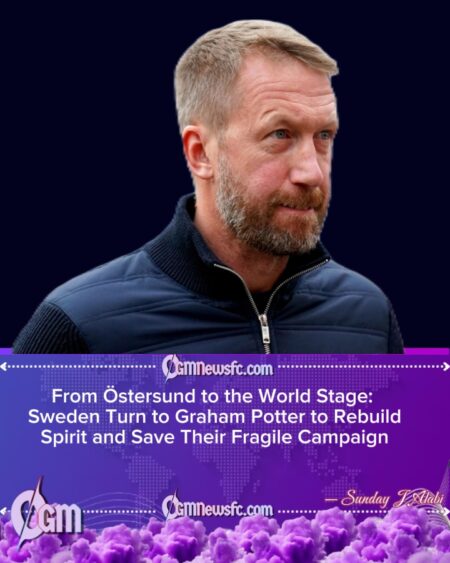
Swedish football has turned to a familiar figure at a moment of crisis, appointing Graham Potter as national team coach in a bid to revive a side whose spirit and structure have badly frayed. The 50-year-old Englishman, who first made his name in Sweden with Östersund, steps into the job with little time to spare and plenty to repair, as the national team battles to keep its World Cup hopes alive.
Potter arrives with an unusually high profile for a Sweden manager, having coached Chelsea and, most recently, West Ham United. Yet his first significant act in charge was to offer comfort rather than revolution. During a training camp in Marbella, he confirmed that Sweden would line up in a variation of the traditional 4-4-2 system – a formation long associated with the country’s most disciplined and effective teams. For many supporters, it was a reassuring signal that Sweden would return to what they know, tactically and psychologically.
The timing has been remarkably fortuitous for both sides. Barely a fortnight after Potter’s dismissal by West Ham, the post in Stockholm became vacant. The Swedish Football Association moved quickly, installing him on a deal initially running until March. For a federation searching for a coach steeped in local football culture, with experience at the highest level and a willingness to accept a lower salary than he commanded in England, Potter represented a rare alignment of circumstances.
A Measured Coach in a Time of Turmoil
Potter’s appointment marks a stark change from the instability that has surrounded some of his recent employers. His spell at Chelsea came during the chaotic early months of Todd Boehly’s ownership, when lavish expenditure and rapid squad turnover created a volatile environment. His return to the Premier League with West Ham placed him in charge of a troubled side struggling for direction. Neither role appeared to match his strengths as a measured, methodical and emotionally intelligent coach, known for elevating underdogs rather than managing superclubs in flux.
Sweden, by contrast, appears a more natural fit. Potter spent seven years in the country with Östersund, taking the modest club from obscurity to European competition and forging deep ties with Swedish football and culture. Those years shaped his reputation as a tactician who marries pragmatism with ambition, and as a man-manager capable of building strong dressing-room bonds in modest surroundings. It is that experience the federation hopes he can now transpose to the national team.
Even so, the job he inherits is no simple rescue mission. Sweden find themselves in a precarious position in World Cup qualifying, bottom of their Group B with just one point. An “astonishing turnaround”, in Potter’s own words, is needed in the space of four days if Sweden are to salvage their campaign. The only solace lies in the Nations League: their strong showing last year means that, even if the group is not salvaged, a playoff route in March remains highly likely. The margin for error, however, is slim, and the expectations heavy.
Sweden Golden Generation, Fragile Campaign
Sweden’s predicament is striking given the quality at their disposal. This is a squad that Dejan Kulusevski once described as capable of becoming “one of the best in the world” after a strong showing against Estonia. The attacking options alone suggest a “goldmine”: Alexander Isak, Viktor Gyökeres, Anthony Elanga, Roony Bardghji, Yasin Ayari and Lucas Bergvall headline a crop of players that many believe could spearhead a new golden era.
Yet under former coach Jon Dahl Tomasson, the pieces never quite fit. Sweden lost their last three matches of his tenure, including two damaging defeats to an ambitious but unfancied Kosovo side. The performance in Gothenburg, where Kosovo left with a memorable win, was particularly alarming: Sweden appeared bedraggled, shapeless and unusually fragile. Tomasson often opted for adventurous attacking approaches that left his team looking loose, gung-ho, and incapable of controlling games for long periods.
The contrast with their neighbours has added to the sense of urgency. In Norway, a much-discussed “golden generation” is marching confidently toward North America, reinforcing a narrative that Sweden are falling behind. Potter’s mission, then, is twofold: he must stabilise the team’s identity and, at the same time, find a way to harness his own star-studded generation before opportunity slips away. Sweden have four games to reclaim their place among the world’s elite – and to prove that recent turmoil is an aberration rather than a new norm.
Injuries, Selection Headaches and the 4-4-2 Gamble
If Potter needed reminding of the difficulties of international management, he received it before his first competitive game. Key players have dropped out or arrived short of full fitness, leaving him with a side rich in talent but thin in availability, particularly in attack. Viktor Gyökeres and Lucas Bergvall are both ruled out. Bergvall, a rising star, has been sent home after suffering lingering concussion symptoms from a recent club match. Kulusevski, another of the team’s marquee names, is also sidelined.
Captain Victor Lindelöf, a pivotal figure in central defence, picked up a minor knock during the week and will not be risked against Switzerland. That leaves Sweden deprived of their on-field leader and one of their most experienced voices in a high-pressure encounter. Meanwhile, the situation surrounding Alexander Isak remains uncertain. The forward has battled groin problems since his record move to Liverpool and is not considered ready to start. “We have to be smart and use him in a good way,” Potter explained, hinting that Isak would be deployed from the bench rather than from the opening whistle.
These setbacks place even greater importance on the collective structure Potter is trying to re-impose. Sweden are not a nation with endless depth; their best teams have historically succeeded through organisation, discipline and collective sacrifice rather than star-laden rotation. The decision to return to a variation of 4-4-2 reflects that reality. It is a system that demands clarity in roles, hard work from wide players and coordinated pressing – hallmarks of the Swedish sides that punched above their weight on the international stage. Against Switzerland, who need a win to secure qualification after a comfortable victory in Stockholm five weeks ago, the question is whether that familiar shape can provide a platform for an upset.
Sweden’s task is plain: they must beat Switzerland and hope Slovenia take points off Kosovo to keep alive their chances of snatching second place, and with it a potentially favourable seeding in the playoffs. For Potter, even signs that his team can compete evenly with the Swiss – tactically disciplined, emotionally resilient, and defensively sound – would represent an important first step.
Potter Rebuilding Spirit On and Off the Pitch
Beyond formations and selection dilemmas, Potter has moved quickly to address what many observers see as Sweden’s deeper problem: a loss of unity and identity. During the Marbella training camp he divided his squad into small groups and asked players to share stories about people who had shaped their careers, from youth coaches to family members. Several squad members described the exercise as unusually open and honest, forging connections that had been missing in recent years.
The new manager has also leaned on the familiarity he built during his years in the country. He conducted his pre-match press conference in Swedish, a language he picked up while working at Östersund. While he modestly played down his fluency, calling it “part of the job”, the gesture was widely noted. It stood in deliberate contrast to Tomasson, the Danish predecessor who preferred to address the media in English and was often criticised for presiding over a setup that felt remote and detached from supporters. Potter’s more inclusive approach has been welcomed as a sign that he understands not just Swedish football, but Sweden itself.
Yet the ultimate judgment will be made on the pitch. Sweden’s reputation as a disciplined, awkward and relentlessly competitive opponent has faded in recent years. Potter, like the team he now leads, has something to prove. After high-profile but turbulent experiences in England, he has a chance to restore his standing by guiding Sweden back to the sport’s grandest stage next summer.
“I wouldn’t be here today without my time in Sweden,” he has said, acknowledging the country’s role in shaping his career. Now, as he returns to familiar ground with the weight of expectation on his shoulders, both coach and country are placing their faith in the idea that going back to what they know – 4-4-2, collective spirit, and a clear identity – can carry them forward to the World Cup once again.