










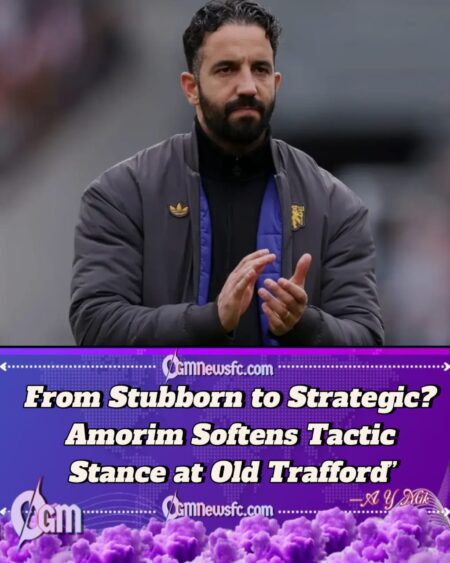
Manchester United manager Ruben Amorim has moved to quiet rising criticism after supporters and pundits accused him of being stubbornly married to his trademark 3-4-3 formation. Following a shock defeat to Everton — and not just any defeat, but one delivered by a side reduced to 10 men — Amorim has now admitted he is “willing to do anything” to get United winning again. For a coach famous for telling journalists that “not even the Pope” could convince him to change his tactical system, this shift is… well, a noticeable development.
The past week has been emotionally heavy at Old Trafford. United’s identity on the pitch has become the subject of talk-show debates, fan frustration, and tactical diagrams so complex they look like IKEA assembly manuals. But with results dipping and goals drying up, Amorim seems to have recognized that a little flexibility may go a long way.
In truth, the manager’s public comments feel like a carefully measured mix of humility and self-preservation. “I’m willing to tweak things if it helps us win,” he said — a sentence many United fans may print, frame, and hang above their mantelpiece.
The Everton Loss That Sparked the Tactical Storm
The defeat to Everton wasn’t just a bad day at the office — it was a Broadway-level spectacle of frustration. Playing with a man advantage after an early red card, United still found a way to lose 1–0, sending fans into collective disbelief. The atmosphere at Old Trafford that evening ranged from stunned silence to that awkward slow clap people do when they’re unsure whether to cry or laugh.
What made the result sting more was the predictability of United’s play. Everton, sitting deep, seemed almost comfortable, watching United’s wide patterns unfold like a television rerun they’d already memorized. The wing-backs pushed high, possession built methodically… and chance creation fizzled out like a flat soda.
The media reaction was swift. Pundits labelled United “tactically rigid,” “undesirably predictable,” and even “a team that only looks dangerous on the chalkboard.” After such a performance, Amorim was always going to face tough questions — and he answered them more openly than usual.
Amorim’s 3-4-3: Blessed, Cursed, or Just Misunderstood?
Amorim’s loyalty to the 3-4-3 system is legendary. It brought him remarkable success at Sporting CP, giving them a league title and an identity sharper than a freshly polished scalpel. The issue? Manchester United doesn’t quite have the Sporting-style pieces to make his puzzle fit seamlessly.
The formation requires dynamic wing-backs, disciplined midfielders, and forwards who thrive drifting into half-spaces. At United, execution has been inconsistent. Some players fit the system like tailored suits; others look like they were handed the wrong clothing size.
Despite this, Amorim initially insisted his principles were non-negotiable. “If anyone wants the system changed, they must change the man,” he said earlier in the season. Strong words indeed… but Premier League reality has proven stronger. And results, as every manager knows, are the ultimate persuasion tool.
What Amorim Says Now — A Softer Tune, Same Philosophy
In his most recent media session, Amorim rejected criticism that he is “fixated” on his formation. Instead, he insisted his tactical blueprint is simply a starting point — not a religious text. “I’m open to adapting. The goal is to win,” he said.
This is a softer, more flexible Amorim — or at least the public version of one. He hasn’t abandoned his philosophy, but he has finally acknowledged what fans have been shouting at their televisions for weeks: that sometimes, especially in England, you must adjust to circumstances. Rainstorms, stubborn opponents, and referees who enjoy 10-minute stoppage-time periods don’t always suit perfectionist tactics.
His remarks also suggest he may finally introduce alternatives when facing teams that sit deep or press aggressively. Whether he actually does this on matchday remains to be seen — but the admission itself is progress.
Media and Fan Reactions: Hopeful, Skeptical, or Just Amused?
The reaction across football media has been lively — part relief, part skepticism, part comic disbelief. After weeks of Amorim insisting the 3-4-3 was untouchable, journalists reacted to his new flexibility like someone watching a notoriously strict parent finally let their child eat ice cream for breakfast.
Portuguese outlets noted that Amorim “contradicted himself” — suggesting his tactical evolution was long overdue. English commentators applauded the honesty while warning that “saying you’ll change and actually changing are two different sports entirely.”
Fans, as usual, delivered the bluntest verdicts. Some rejoiced, tweeting things like “WE ARE FREE AT LAST.” Others fear the announcement might be pure PR — like pressing the snooze button without waking up. Either way, the mood is shifting, and that alone is newsworthy.
What Tactical Tweaks Could Look Like at Old Trafford
Now the fun part: speculating what Amorim might actually do next. Should he deviate from the 3-4-3, even temporarily, several possibilities open up:
Switch to a back four, allowing more attackers and more central control.
Adopt a 4-3-3, which many analysts argue better fits the current squad’s strengths.
Go hybrid, keeping the principles of his philosophy while introducing adaptive shapes during matches.
Track-specific adjustments, changing systems depending on whether United face a low block, high press, or transitional threat.
United’s players could benefit enormously from these adjustments — especially attacking midfielders who often become spectators in the current setup. Tactical flexibility may be exactly what the squad, and the results column, desperately need.
A New Chapter or a Momentary Wink?
The biggest question is whether this “willingness to change” marks a true turning point or just a brief moment of introspection. Managers often promise flexibility — then revert to their beloved systems the moment kickoff arrives.
Still, Amorim’s tone has clearly shifted. A manager who once spoke like the guardian of a sacred tactical scripture is now acknowledging that football — especially Premier League football — is chaotic, unpredictable, and unforgiving of rigidity.
If United’s upcoming fixtures show evidence of fresh ideas and new shapes, the club may look back at that Everton defeat as the embarrassing moment that inspired necessary evolution. If not? Well, fans may once again ask whether only divine intervention can help United solve the tactical equation.