




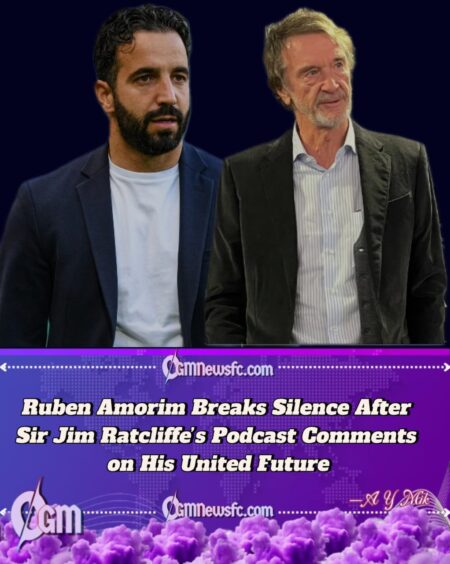
Manchester United co-owner Sir Jim Ratcliffe has publicly expressed his support for manager Ruben Amorim, emphasizing patience and long-term planning as the club continues its rebuilding process. Speaking during the international break on The Business podcast, Ratcliffe discussed Amorim’s future, the state of United’s academy, and his broader vision for the club under the new sporting structure.
Ratcliffe admitted that Amorim “has not had the best of seasons,” but insisted that true managerial greatness is proven over time, not through immediate results. “Ruben needs to demonstrate he is a great coach over three years. That’s where I would be,” Ratcliffe stated. His comments have been widely interpreted as a sign of trust and stability at a club that has seen constant managerial turnover since Sir Alex Ferguson’s retirement.
The message was clear — Manchester United’s leadership is determined to give Amorim the time and resources he needs to implement his philosophy fully. After years of short-term fixes, this could signal a shift toward a more sustainable model that prioritizes structure, development, and identity.
Amorim’s Response: Gratitude Mixed With Realism
In his pre-Liverpool press conference, Ruben Amorim was asked directly about Ratcliffe’s remarks, and his response reflected both appreciation and awareness of football’s unpredictable nature. The Portuguese coach acknowledged Ratcliffe’s backing, revealing that the United co-owner often sends him messages after games to offer encouragement.
“He tells me all the time, sometimes with a message after games,” Amorim said. “But you know, I know and Jim knows that football is not like that. The most important thing is the next game. You cannot control the next day. But it is really good to hear that.”
Amorim also expressed how the internal communication from Omar Berrada and Jason Wilcox, two key figures in United’s new sporting setup, has reinforced Ratcliffe’s message of support. Yet, the manager made it clear that such reassurance does not reduce his own personal pressure to deliver results. “Sometimes the pressure I put on the team and myself is so much bigger,” he admitted.
Balancing Long-Term Vision With Short-Term Demands
While Amorim welcomed the patience shown by United’s hierarchy, he also stressed that he does not want this sentiment to breed complacency within the squad. The former Sporting CP manager understands that Manchester United’s fans expect immediate improvement, especially after another inconsistent start to the Premier League season.
“It is really good to hear that. I think it helps our fans to understand that leadership know it is going to take a while,” Amorim said. “But at the same time, I don’t like that because I don’t want that feeling in our club. We need to prove that every week we are ready to win games.”
This dual perspective reflects Amorim’s coaching philosophy — a blend of patience in building systems and urgency in performance. His focus remains on ensuring that each match reflects progress in terms of structure, mentality, and tactical execution.
For Amorim, every fixture is an opportunity to move closer to the standards expected at Old Trafford, and he insists that results must improve even during this transitional phase.
Jim Ratcliffe’s Criticism of Manchester United’s Academy
During the same interview, Sir Jim Ratcliffe also made headlines by openly criticizing the club’s once-celebrated academy system, claiming its standards have “really slipped” in recent years. He suggested that United must rediscover its commitment to nurturing homegrown talent — a principle that defined the club during the Ferguson era.
Ratcliffe’s comments reflect a growing frustration within the ownership about the declining number of academy graduates breaking into the first team. While players like Kobbie Mainoo and Alejandro Garnacho have offered hope, the broader system appears to be lagging behind rivals such as Manchester City and Chelsea in terms of youth development infrastructure and technical standards.
When asked to respond, Amorim was measured, acknowledging that improvement is necessary but also emphasizing his limited time at the club. “I think we can always improve,” he said. “I am not the best guy because I am here for a year.”
The New United Project: Patience, Planning, and Structure
Sir Jim Ratcliffe’s INEOS-led vision for Manchester United revolves around long-term stability, data-driven recruitment, and the creation of a sustainable sporting identity. The appointment of Omar Berrada as CEO and Jason Wilcox as technical director are seen as key steps toward modernizing the club’s football operations.
Amorim fits into this blueprint as a forward-thinking coach capable of developing young players and implementing a tactical style rooted in discipline and intensity. His time at Sporting CP demonstrated his ability to rejuvenate a club from within — a quality that appeals to Ratcliffe’s new leadership team.
The message to fans and media alike is clear: United’s leadership wants to build, not just buy, success. While that process may take years rather than months, the intention is to restore United’s competitiveness through structure and culture rather than short-term spending sprees.
Pressure, Patience, and the Road Ahead
As Manchester United prepare for their next test against Liverpool, the conversation surrounding Amorim’s tenure continues to evolve. The clash at Anfield will serve as another litmus test for United’s progress under his management — both tactically and mentally.
The Portuguese coach remains grounded, aware that public endorsements mean little without tangible improvement on the pitch. “The most important thing is the next game,” he repeated. “We need to prove that every week we are ready to win games.”
For Amorim, Ratcliffe’s backing offers security, but it also raises expectations. The real challenge lies in translating that confidence into performances that remind fans why Manchester United chose him as the man to lead their new era.
If Amorim succeeds, Ratcliffe’s three-year vision may not only redefine United’s future — it could finally mark the end of the instability that has haunted Old Trafford for over a decade.