





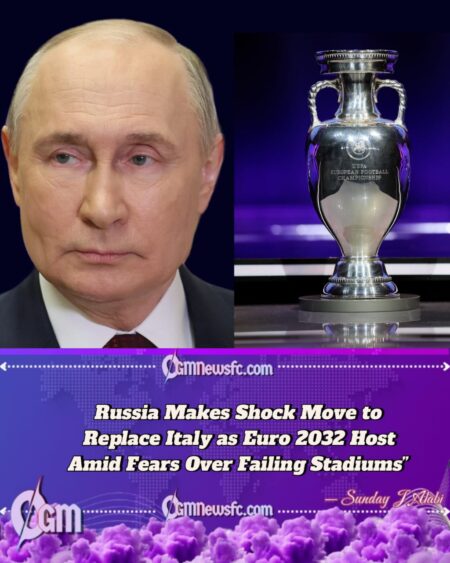
In a stunning twist, Russia has declared its readiness to replace Italy as co-host of the UEFA Euro 2032 tournament, despite the country’s ongoing ban from international football. The bold statement was made by Moscow Football Federation President Alexander Dyukov, who claimed Russia could step in should Italy fail to meet UEFA’s stadium standards.
The Euro 2032 championship is currently scheduled to be jointly hosted by Italy and Turkey. However, growing concerns over Italy’s outdated infrastructure and slow pace of stadium renovation have prompted fresh debate about the nation’s preparedness.
Dyukov, speaking to Russian sports outlet Sport.ru and quoted by Italy’s Gazzetta dello Sport, said, “Italy has a stadium problem. If they lose their organization, we’re here. Russia is ready to host Euro 2032 instead of Italy.” His remarks have stirred intense reactions across European football circles, given Russia’s current isolation from UEFA and FIFA activities following the invasion of Ukraine in 2022.
Italy’s Stadium Crisis Deepens
Italy’s football infrastructure has been under scrutiny for years. Many of its historic stadiums — such as Milan’s San Siro and Rome’s Stadio Olimpico — have become symbols of both heritage and decay. Modernisation projects often face delays due to bureaucratic red tape, heritage preservation laws, and sluggish government approvals.
UEFA President Aleksander Ceferin previously described Italy’s stadium situation as “a shame,” warning that the country had “by far the worst infrastructure among major football nations.” His comments underscored UEFA’s frustration with Italy’s inability to meet modern hosting standards, especially with the tournament less than seven years away.
Italian league president Ezio Simonelli echoed these fears in August, admitting that the nation risks “embarrassing itself internationally.” He stated: “Our stadiums are in a comatose state. If the situation does not improve, we might lose our candidacy. We are pressing the government to cut through the endless bureaucracy holding us back.”
UEFA’s Concern Over Italy’s Readiness
UEFA’s concern stems from reports suggesting that only one of the ten proposed Italian venues has so far met the organization’s requirements. This revelation has raised doubts about whether Italy can deliver a successful tournament within the expected timeframe.
Turkey, Italy’s co-host, is reportedly being considered as a potential sole host should Italy’s delays persist. Turkish infrastructure has improved significantly in recent years, following major investments in new stadiums and transport systems.
Ceferin has not publicly commented on Russia’s new bid, but UEFA insiders reportedly view Dyukov’s statement as “symbolic rather than realistic,” given the ongoing geopolitical climate and Russia’s suspended status in global football governance.
Russia’s Sporting Isolation and Strategic Play
Since its invasion of Ukraine in 2022, Russia has been excluded from UEFA and FIFA competitions. Despite this, the nation continues to organize domestic tournaments and friendly matches against non-Western countries, including nations in Asia, Africa, and the Middle East.
Russia previously submitted bids for both Euro 2028 and Euro 2032 before being declared ineligible. Analysts believe this new push is part of Moscow’s broader effort to signal a return to international sports diplomacy and rehabilitate its global image through football.
Dyukov’s confident tone suggests that Russia is attempting to remain visible in the football conversation, even if the prospect of hosting is virtually impossible under current sanctions. His statement also reflects Russia’s desire to portray itself as a capable and ready alternative amid perceived Western dysfunction.
The Road Ahead for UEFA and Italian Football
While Russia’s bid is unlikely to be taken seriously, it highlights genuine and growing concerns over Italy’s preparedness. With the clock ticking toward 2032, the Italian government and football federation face mounting pressure to fast-track stadium redevelopment and prove their capability to host one of the world’s most prestigious tournaments.
Simonelli’s plea to the Italian authorities remains urgent: “We are behind every other European nation. In 18 years, we’ve built only six new stadiums — just three in Serie A. If we don’t act now, we risk humiliation.”
As Italy scrambles to modernize and Russia watches from the sidelines, the question for UEFA is becoming increasingly pressing: Can Europe’s football heartland rise to the challenge, or will its slow-moving system cost it the continent’s crown jewel of football tournaments?