










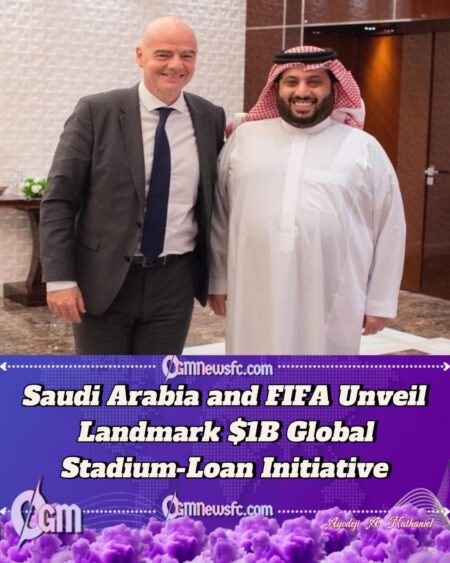
Saudi Arabia and FIFA have launched a groundbreaking $1 billion stadium-loan initiative designed to transform global football infrastructure. Saudi Arabia and FIFA describe the fund as a long-term strategic partnership that will significantly expand access to modern sporting facilities across dozens of member nations. The program will be financed through Saudi Arabia’s powerful development arm, the Saudi Fund for Development (SFD).
Saudi Arabia and FIFA highlighted that the initiative aims to ensure that footballing nations—regardless of size or economic status—can upgrade or construct stadiums that meet international standards. Many countries have long struggled with facility deficits, limiting their ability to host major tournaments and develop grassroots programs.
Saudi and FIFA’s joint statement emphasizes that the loans will be offered at low interest rates to reduce financial barriers for federation projects. This marks one of the most ambitious football-development programs ever undertaken by a non-governmental sports body in collaboration with a sovereign institution.
Saudi Arabia and FIFA Outline Loan Structure and Eligibility
Saudi Arabia and FIFA confirmed that the $1 billion fund will be open to all 211 FIFA member associations. Eligible nations will be able to access financing for new stadium construction, expansion of existing venues, or critical safety and technology upgrades.
Saudi Arabia and FIFA also explained that SFD will assess each application individually to ensure project feasibility and alignment with broader development goals. This includes financial sustainability, environmental considerations, and projected community impact. Countries with historically limited infrastructure are expected to benefit most.
Saudi and FIFA stressed that the initiative aims to reduce global disparities in football facilities. By granting more nations access to modern stadiums, FIFA hopes to create a more competitive and inclusive global football landscape.
Saudi Arabia and FIFA Emphasize Global Football Development
Saudi Arabia and FIFA framed the initiative as part of a wider commitment to support global football growth. For FIFA, the plan aligns with President Gianni Infantino’s goal of ensuring that every region can compete for hosting rights and access better resources for players and fans.
Saudi and FIFA note that improved stadiums will also help countries host youth tournaments, women’s championships, and larger continental events. Such opportunities often stimulate local economies and accelerate sports development pathways for young athletes.
Saudi Arabia and FIFA further expressed hope that strengthening infrastructure in developing nations will help balance competitive inequality. Many federations lack the basic facilities required for elite preparation, making participation in major competitions more challenging.
Saudi Arabia and FIFA Strengthen Strategic Partnership
Saudi Arabia and FIFA appear increasingly aligned on global football development priorities. The SFD’s involvement signals Saudi expanding influence in international sports diplomacy, a role the kingdom has embraced in recent years through significant investment in global sporting events and organizations.
Saudi Arabia and FIFA representatives both emphasized that this collaboration does not merely reflect financial support but a shared vision for the sport’s future. By leveraging Saudi Arabia’s financial resources and FIFA’s global network, the initiative is expected to create long-term, sustainable impact.
Saudi and FIFA also highlighted that the initiative could serve as a model for future partnerships between major global institutions and international sports bodies, reinforcing the trend of cross-sector cooperation in sports development.
Saudi Arabia and FIFA Project Long-Term Impact on Member Nations
Saudi and FIFA expect the $1 billion initiative to reshape football infrastructure across continents over the coming decade. Countries in Africa, Asia, Oceania, and Latin America are projected to be the primary beneficiaries, especially those unable to secure private financing for large-scale stadium projects.
Saudi and FIFA argue that these upgraded venues will not only elevate national-team performance but also promote tourism, create jobs, and support local community events. Modern stadiums increasingly function as multi-purpose hubs, attracting commercial investment and social engagement.
Saudi and FIFA conclude that the initiative marks a historic step toward reducing inequality in global football while positioning the sport for future growth. For many federations, this development could become the catalyst needed to compete on the world stage.