










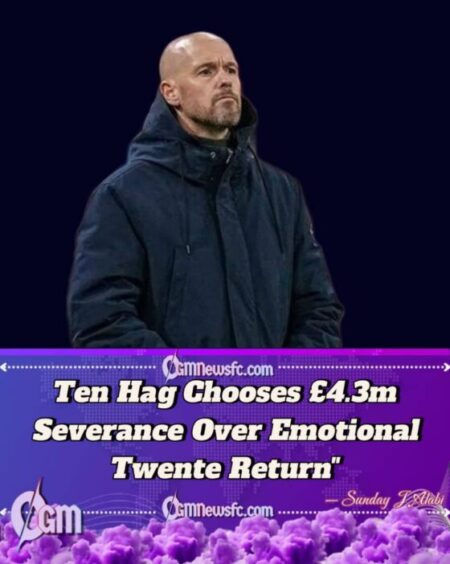
Erik ten Hag has stunned the football world by rejecting an offer to manage his beloved FC Twente, the club where he began his playing career and has repeatedly professed his “big love.” The 55-year-old Dutchman’s decision comes just two weeks after his shocking dismissal from Bayer Leverkusen, where his tenure lasted merely two Bundesliga matches.
According to reports from German outlet Bild, Ten Hag is set to receive approximately £4.3 million in severance pay from Leverkusen, equivalent to around £69,000 for each day he worked at the BayArena. This substantial compensation package is to be paid over time, but crucially, Ten Hag would forfeit the entire amount if he accepts another managerial position.
The financial implications of this decision cannot be understated. Having endured a turbulent end to his Manchester United tenure last season, Ten Hag appears to be prioritizing financial security over the emotional pull of returning to his roots. This pragmatic approach, while understandable from a business perspective, has left many questioning whether money has triumphed over passion in modern football management.
Twente’s Hour of Need: A Club in Crisis
FC Twente’s approach to Ten Hag comes at a desperate time for the Eredivisie club. Five games into the new season, they find themselves languishing in 13th position out of 18 teams, precariously placed just two points above the automatic relegation zone. The club’s hierarchy had identified Ten Hag as the ideal candidate to arrest their alarming slide down the table.
The timing of Twente’s struggles makes Ten Hag’s rejection all the more painful. The club that nurtured him from youth level through to professional football, and where he experienced some of his greatest triumphs, now faces the prospect of a relegation battle without their prodigal son’s guidance. Their current predicament represents a stark contrast to their recent history, having enjoyed periods of success including their memorable Eredivisie title triumph in 2010.
Twente’s desperation to secure Ten Hag’s services likely reflects both his intimate knowledge of the club’s culture and his proven track record in Dutch football. However, the financial realities of modern football management have ultimately proved more compelling than sentiment and loyalty.
From Academy to Legend: Ten Hag’s Twente Legacy
Ten Hag’s connection to FC Twente runs deeper than most manager-club relationships in modern football. As an academy graduate, he embodied the club’s values and traditions from his earliest days in professional football. His playing career with Twente spanned 262 appearances across three separate stints, demonstrating a loyalty that was reciprocated by the club’s supporters who regarded him as one of their own.
The pinnacle of his playing career came in 2001 when he captained Twente to KNVB Cup glory, one of only three times in the club’s history they have claimed this prestigious trophy. This triumph held special significance, coming just one year after the devastating Enschede fireworks warehouse explosion that killed 23 people and injured 950 others in the city. Ten Hag later reflected on how the cup victory helped restore pride to a community still reeling from tragedy.
His formative experiences at Twente were profoundly influenced by youth coach Epi Drost, who became Ten Hag’s mentor and idol. Drost’s philosophy of adventurous, creative football left an indelible mark on Ten Hag’s tactical approach. The tragic loss of Drost to a heart attack during a match in 1995, when the coach was just 49, deeply affected Ten Hag and shaped his perspective on football’s place in life’s broader context.
Coaching Journey: Building a Reputation
After retiring as a player in 2003, Ten Hag’s transition into coaching began at the very club where his playing career had flourished. Starting as an under-17 coach at Twente, he methodically worked his way through the youth ranks before progressing to lead the under-19 team for three years. This grassroots experience provided him with invaluable insights into player development and tactical nuances.
His ascension continued when he became an assistant manager, working alongside former England boss Steve McClaren during the latter’s tenure at Twente in 2008. Although Ten Hag had departed by the time Twente claimed their historic Eredivisie title later that year, his contributions to the club’s development were widely acknowledged. Former teammate Boudewijn Pahlplatz has revealed that Ten Hag expressed a desire to return to “The Tukkers” as manager one day.
The foundation laid at Twente ultimately propelled Ten Hag to greater heights. His subsequent five-year stint at Ajax from 2017 to 2022 established him as one of Europe’s most promising coaches. At Ajax, he secured three Eredivisie titles and two KNVB Cups, while also guiding the club to the Champions League semi-finals in the memorable 2018-19 campaign that captured global attention.
The Road Ahead: Uncertain Future
Ten Hag’s rejection of Twente’s overtures leaves both parties facing uncertain futures. For the Dutch manager, the decision to prioritize his Leverkusen severance package may provide short-term financial security but could impact his long-term reputation and emotional well-being. Having been dismissed after just two matches at Leverkusen, his stock in European football has undoubtedly diminished.
The brevity of his German adventure raises questions about his adaptability and whether the tactical approach that succeeded in the Netherlands and initially showed promise at Manchester United can translate to other European leagues. His next career move will be crucial in determining whether he can restore his reputation as one of Europe’s elite coaches or whether the recent setbacks represent a more fundamental decline.
For FC Twente, the search for a new manager continues as they battle to avoid relegation. The club must now look elsewhere for the leadership and inspiration needed to climb the Eredivisie table. While Ten Hag’s rejection stings, particularly given his deep connections to the club, Twente’s hierarchy must focus on identifying an alternative candidate who can provide the stability and tactical acumen required for their current predicament. The romantic notion of a homecoming will have to wait for another day, another season, and perhaps different financial circumstances.