










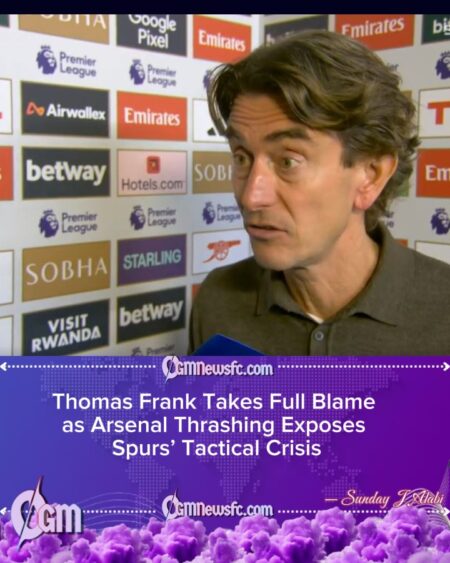
Tottenham’s trip to the Emirates turned into a nightmare as Arsenal stormed to a 4–1 victory in a one-sided North London derby that raised fresh questions about Spurs’ direction under Thomas Frank. What was billed as a statement game for a rebuilding Tottenham side quickly descended into a humbling lesson from their title-chasing neighbours.
From the opening whistle, Arsenal played with purpose, intensity and clarity, while Spurs looked disjointed, passive and unsure of their shape. The damage was effectively done early in the second half when Arsenal struck again after the interval, capitalising on Tottenham’s tactical confusion and defensive fragility. By the time the final whistle blew, the away end had largely emptied, leaving a stark visual image of disillusioned supporters voting with their feet.
The result leaves Tottenham languishing in ninth place, a full 11 points behind Arsenal in the Premier League table. For a club that lifted the Europa League trophy only a few months ago but also finished 17th in the league last season, the derby collapse underlined how fragile their domestic rebuild still is — and how unforgiving the top flight can be when tactical experiments go badly wrong.
Thomas Frank’s Tactical Gamble Backfires
Thomas Frank did not hide from the criticism. He openly accepted that his tactical approach – a back five in a 5-4-1 system – had backfired badly. It was only the second time Tottenham had started with that set-up, having tried it previously in the European Super Cup against Paris Saint-Germain, a match they also lost. This time, against an Arsenal side well-drilled in pressing and exploiting space, the structure crumbled under pressure.
“I will always take the full responsibility,” Thomas Frank said afterwards, repeatedly stressing that the blame lay firmly with him. “We picked a team that played 5-4-1, changed it at half-time, and one minute into it they scored. 3–0. Then the rest is history.” His words reflected a manager painfully aware that his tactical tweak had not merely failed, but contributed directly to the scale of the defeat.
Thomas Frank insisted that, in principle, he remains “a very big believer that no matter what system you play you can be successful.” Yet he admitted that the execution was lacking across the board. Spurs did not press with enough aggression, they were second-best in duels, and their defensive shape invited Arsenal to dictate the terms. System or not, Thomas Frank accepted that his team were not brave or proactive enough in any phase of play.
Creativity Crisis and Damning xG Numbers
Beyond the scoreline, the underlying statistics painted an equally bleak picture for Tottenham. They registered an expected goals (xG) figure of just 0.07 – the lowest by any side in a Premier League match this season and, remarkably, their second such unwanted record after posting 0.1 xG against Chelsea earlier in November. For an attacking unit that should be evolving, those numbers point to a deep creative crisis.
Thomas Frank acknowledged the seriousness of those figures but insisted that the lack of creativity was only part of his wider concern. “We are working very hard to try to make that better,” he said. “But sometimes it’s not only playing out and finding a nice pass. In a game like this, when Arsenal won it high, there was a little bit more open space. We didn’t win it enough in those situations and then create from that.” In other words, Spurs were neither secure enough in possession nor effective in transition.
For long spells, Tottenham looked passive and reactive. When they finally did get on the ball, they failed to sustain attacks or get out of tight areas. “It means we got pushed back and got a little too passive. It looks like we are running after them,” Thomas Frank admitted. The combination of timid pressing, slow build-up and minimal threat in the final third left Spurs looking miles behind the level required to compete with a side like Arsenal.
Fans’ Fury and a Manager Under Pressure
If the performance on the pitch was bad, the scenes in the stands compounded the sense of crisis. By the closing stages, the away section was visibly empty, with many Tottenham fans heading for the exits long before full-time. Their early departure was a blunt verdict on what they had just witnessed: a derby no-show in one of the fixtures that matters most to them.
Thomas Frank was quick to address those supporters directly. “This is of course hugely disappointing that we didn’t perform better in the game against Arsenal, our biggest rivals,” he said. “I can only apologise to the fans for that.” The Dane revealed he had felt confident going into the game, believing Spurs could be as competitive as they had been against Manchester City and PSG in recent months. Instead, they fell well short of that standard.
The result inevitably ramps up the pressure on Thomas Frank. While there is recognition that he inherited a team that finished 17th last season, patience is not limitless at a club that demands progress and pride in fixtures of this magnitude. When a manager publicly takes “full responsibility” and admits his players looked like they were “running after” the opposition, it invites scrutiny of both his selections and his game management. The derby defeat may not be decisive on its own, but it has certainly sharpened the debate about whether Spurs are truly moving in the right direction.
Rebuild, Reality Check and Plea for Patience
Despite his frank self-criticism, Thomas Frank also urged observers to consider the wider context. He reminded everyone that Tottenham are only four months into his tenure and still in the early stages of a long-term rebuild. “I think it’s also fair to say where we’re coming from. We finished 17th last year,” he said. “And we’ve tried to build something, which today didn’t look like we tried to build something.” The admission was brutally honest: the project he is trying to construct was nowhere to be seen at the Emirates.
Thomas Frank pointed to Arsenal’s six-year head start in their own transformation under their current structure and philosophy, arguing that such gaps cannot be bridged overnight. “No matter how painful it is to admit, they are definitely six years down the line and we are four months down the line,” he observed. Even with that in mind, he confessed he had expected far more from his team — not domination over 90 minutes, but at least the same competitiveness they showed against Manchester City and PSG.
“I think there’s definitely a lot to work on still,” he concluded. “We are very disappointed and unhappy with the performance today. I don’t want to run away from that. As I said, I apologise to the fans.” The task now for Frank is to turn words into action: to refine the tactical plan, restore confidence, and ensure that this derby humiliation is a turning point rather than a defining moment. For Spurs, and for their embattled manager, the response in the coming weeks will reveal whether this was just a brutal lesson — or a warning sign of deeper problems ahead.