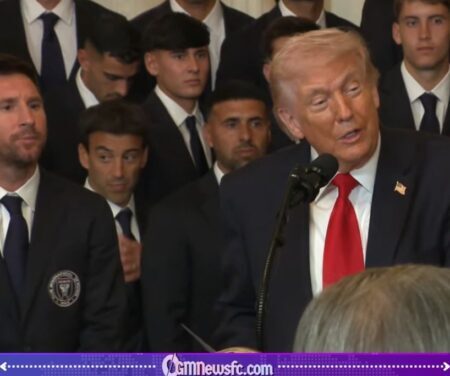









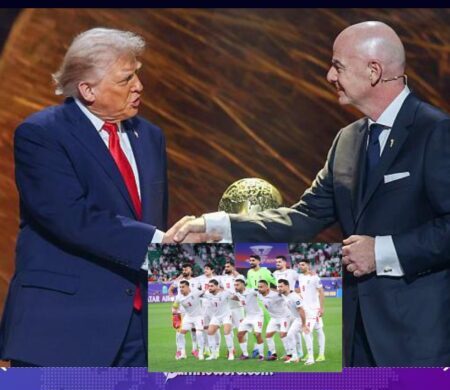
United States President Donald Trump has indicated that Iran will be allowed to participate in this summer’s FIFA World Cup despite ongoing hostilities between the two countries, according to FIFA President Gianni Infantino. The statement comes as preparations intensify for the global tournament, which will be jointly hosted by the United States, Canada, and Mexico beginning on June 11.
Infantino disclosed the development after a meeting with Trump in Washington, where discussions focused on the upcoming tournament and broader geopolitical developments, including the conflict involving Iran. According to the FIFA chief, Trump reaffirmed that the Iranian national team would be permitted to compete in matches scheduled in the United States, signaling a separation between political tensions and the world’s most widely watched sporting event.
Diplomatic Signals from Trump Administration
During the meeting, Infantino said Trump reiterated that Iran’s national football team would be “welcome” to participate in the World Cup matches planned in the United States. The assurance comes amid a period of significant geopolitical tension following recent military confrontations involving the United States, Israel, and Iran.
Infantino later shared details of the meeting on Instagram, emphasizing the role of global sporting events in promoting unity during turbulent times. According to him, the conversation highlighted the importance of maintaining the World Cup as a platform that brings people together regardless of political divisions.
The FIFA president thanked the Trump administration for its support of the tournament, stating that football remains one of the few global institutions capable of bridging cultural and political divides. His remarks reflected FIFA’s long-standing stance that international competitions should remain open and inclusive.
War in the Background of Global Football
Iran’s participation in the tournament had been uncertain after military strikes carried out by the United States and Israel targeted locations in Iran earlier this month. The attacks reportedly resulted in the death of Iran’s Supreme Leader, Ayatollah Ali Khamenei, significantly escalating tensions across the region.
In response, Iran launched missiles and drones toward Israel and several Gulf Arab nations hosting American military bases, including Bahrain, Kuwait, Qatar, and the United Arab Emirates. The developments raised questions about whether the conflict could affect Iran’s ability to compete in the World Cup.
Security experts have also warned that geopolitical instability could influence travel arrangements, security planning, and diplomatic relations during the tournament, particularly as several participating teams will play matches in the United States.
Iran’s Scheduled Matches in the United States
Despite the tensions, Iran remains scheduled to play three group-stage matches in the United States during the tournament. According to the current fixtures, Iran will face New Zealand in Los Angeles on June 15, followed by a match against Belgium in the same city on June 21.
The Iranian team is also expected to travel to Seattle for a third group match against Egypt on June 26. These matches are expected to attract significant global attention due to both sporting interest and the wider political context surrounding Iran’s participation.
President Trump had earlier appeared less concerned about the issue when asked about Iran’s involvement in the tournament. In comments reported last week, he said he “really doesn’t care” whether Iran participates, remarks that drew mixed reactions among political observers and football fans.
Uncertainty Within Iran’s Football Community
Inside Iran, reactions to recent developments have reflected a mixture of concern and uncertainty. Mehdi Taj, president of Iran’s football federation, suggested that the ongoing conflict has cast doubt on the nation’s ability to focus on the upcoming tournament.
Speaking after the recent attacks, Taj said it had become difficult to view the World Cup with optimism under the current circumstances. His comments highlighted the psychological and logistical challenges facing athletes preparing for major competitions during periods of national crisis.
Analysts note that sports organizations often face complex decisions during conflicts, as governments, international bodies, and athletes must navigate both political pressures and the expectations of global audiences.
Humanitarian Concerns Surrounding Iranian Athletes
Beyond the men’s national team, humanitarian concerns have also emerged regarding Iranian athletes competing internationally. Australia recently granted humanitarian visas to members of Iran’s women’s football team amid fears for their safety.
Australia’s Home Affairs Minister Tony Burke confirmed that seven individuals were initially granted asylum. However, one of the women later chose to withdraw her request and return home.
The rest of the players departed Australia after their team’s elimination from the AFC Asian Cup. The situation underscores the broader challenges facing Iranian athletes competing abroad during periods of political uncertainty and heightened security risks.