
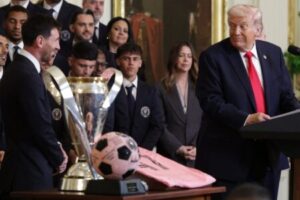



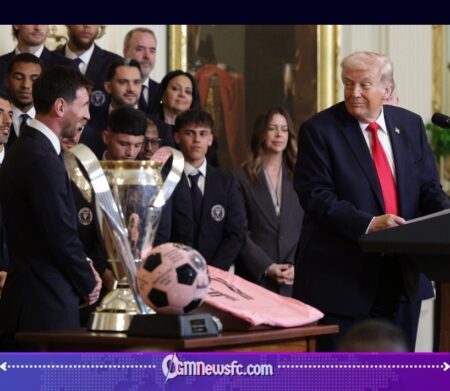
The celebration of a major sporting achievement took an unexpected turn when the 2025 Major League Soccer champions, Inter Miami CF, visited the Donald Trump at White House. What was meant to be a traditional recognition of their triumph quickly evolved into a moment dominated by political commentary from the President of the United States, Donald Trump.
With global football icon Lionel Messi standing beside the podium and teammates lined up behind, the ceremony began with a lengthy speech that initially made little mention of the team’s achievement. Instead, it moved through geopolitical updates, economic commentary, and personal anecdotes, leaving the visiting players largely silent observers during the opening portion of the event.
A Ceremony Marking a Historic MLS Triumph
The White House invitation followed Inter Miami’s victory in the 2025 Major League Soccer championship, a title that secured their place among the elite teams in American soccer. The traditional visit recognizes champions across major U.S. sports leagues, giving players an opportunity to celebrate their success at the highest level of national recognition.
During the event, President Trump eventually acknowledged the club’s accomplishment and welcomed Messi, marking the Argentine star’s first official appearance at the White House during his playing career in the United States. The president Trump described the moment as historic, noting that no previous American leader had welcomed Messi in this capacity.
Club owner Jorge Mas also addressed the audience, emphasizing the significance of the moment for the team and highlighting the journey of the club since its founding. Mas described the occasion as an “honor and privilege,” framing the visit as both a celebration of sporting excellence and a symbol of opportunity within American society.
Political Remarks Dominate the Early Moments
The ceremony began with nearly ten minutes of remarks before the championship victory was formally acknowledged. During this opening segment, President Trump discussed international developments, including tensions involving Iran and broader issues surrounding U.S. foreign policy and the national economy.
These comments created a contrast between the intended focus of the ceremony—recognizing a sports team—and the political themes raised during the speech. As the president spoke, Messi and several teammates, including Uruguayan striker Luis Suárez, stood quietly behind the podium, watching the proceedings without participating in the discussion.
Observers noted that the tone resembled earlier appearances involving international football teams at the White House. In some cases, such events have blended sports recognition with broader political messaging, placing visiting athletes in the background of national political discourse.
Messi’s Reserved Public Persona
Messi’s reaction during the ceremony reflected the approach he has maintained throughout his career: remaining largely neutral in political matters. Throughout the event, the Argentine forward responded with nods and smiles while the president shared personal anecdotes, including references to his son’s admiration for both Messi and his longtime rival, Cristiano Ronaldo.
The forward has historically avoided public alignment with political movements or government leaders. During his years at FC Barcelona, a club often associated with regional political discussions, Messi rarely commented on issues such as Catalan independence, unlike figures such as Gerard Piqué or coach Pep Guardiola.
His neutral stance contrasts with that of another Argentine football legend, Diego Maradona, who frequently expressed strong political views during and after his playing career, including criticism of U.S. foreign policy.
Trump’s Relationship With Soccer and the 2026 World Cup
President Trump has occasionally been described as a supporter of soccer, dating back to his involvement with American soccer culture in the 1970s and his public admiration for Brazilian legend Pelé. His presidency also coincides with the upcoming global tournament hosted jointly by the United States, Canada, and Mexico.
That tournament, the 2026 FIFA World Cup, is expected to be one of the largest sporting events in history. The U.S. government has been actively involved in preparations, with Gianni Infantino, president of FIFA, frequently appearing alongside Trump at international events connected to the tournament.
Despite these associations, critics argue that the president Trump public comments about soccer have often been brief or secondary to broader political narratives. The White House ceremony for Inter Miami reflected that dynamic, with the team’s sporting success sharing the stage with wider political commentary.