








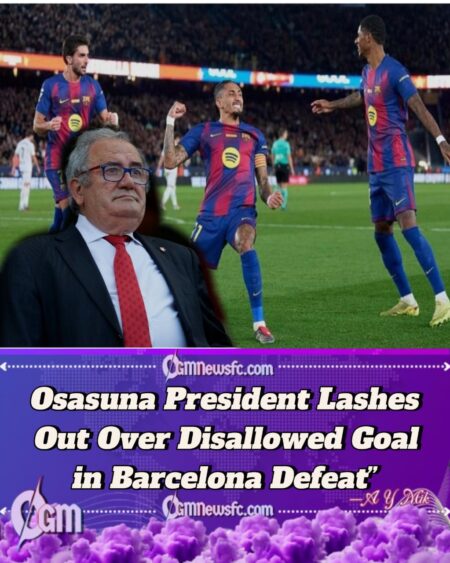
Barcelona’s 2–0 victory over Osasuna at the Spotify Camp Nou should have been remembered simply as another efficient home win powered by Raphinha’s second-half brilliance. Instead, the match has sparked fresh controversy in La Liga, with Osasuna’s president fuming over a disallowed goal that he insists unfairly changed the game’s direction.
What began as a routine league fixture quickly turned into a familiar Spanish football drama — goals, VAR lines, press-conference anger, and a president who felt his club had been “harmed.” Once again, football didn’t end at the final whistle.
A Calm First Half, Then Chaos Waiting in the Wings
The opening half of the match was largely measured and tactical, with Barcelona dominating possession while Osasuna remained disciplined and compact. Chances were few, tempers stayed cool, and the crowd sensed a slow-burn encounter rather than fireworks.
Osasuna, far from overawed by the Camp Nou atmosphere, showed flashes of ambition. Their defensive shape frustrated Barcelona’s forwards, and when opportunities arose on the counter, the visitors looked capable of causing problems. It was the kind of first half that suggested a tight contest still wide open.
That sense of balance, however, would not last long once VAR entered the conversation.
The Disallowed Goal That Changed Everything
Midway through the game, Osasuna thought they had struck gold. A move involving defender Alejandro Catena ended with the ball in the net, prompting brief celebrations from the visiting bench. For a moment, the stadium fell silent — then the VAR review began.
After checks, the goal was disallowed, triggering confusion and disbelief from Osasuna players. Replays and VAR animations soon flooded screens, but instead of clarity, they brought controversy. The decision was upheld, yet debate erupted almost instantly about whether the offside call — and its visual representation — truly matched what fans saw on the pitch.
From that point on, the game tilted decisively in Barcelona’s favour.
Raphinha Delivers While Barcelona Keep Their Cool
With Osasuna deflated and protesting decisions, Barcelona found their rhythm. Raphinha emerged as the difference-maker, scoring twice in the second half to secure all three points. His first goal broke the resistance; the second ended any realistic hope of an Osasuna comeback.
Barcelona’s performance was professional rather than spectacular, but it was effective. They controlled possession, limited Osasuna’s chances, and capitalised when space opened up. From a purely sporting angle, it was a textbook home win.
Yet, even as Raphinha celebrated, the conversation outside the pitch was heading in a very different direction.
Osasuna President Explodes: ‘We Have Been Harmed’
After the match, Osasuna president Luis Sabalza did not hide his frustration. Speaking to the press, he openly criticised the refereeing decision, declaring that his club had been “harmed.” His tone was blunt, his message clear: Osasuna felt robbed of a fair chance.
The president questioned not only the decision itself but also the consistency of VAR usage across La Liga. In his view, similar situations have produced different outcomes elsewhere — a claim many clubs have made before him. His remarks echoed a growing league-wide frustration that VAR, designed to reduce controversy, often seems to multiply it.For Osasuna, the defeat now feels heavier than a simple 2–0 loss.
VAR, Hawk-Eye and the Art of Drawing Lines
Adding fuel to the fire were questions surrounding the semi-automated offside system and the VAR animation used during the decision. Some observers argued that the visual representation appeared misleading, sparking debates across television studios and social media timelines.
Hawk-Eye, the technology provider, later explained that perspective and camera angles can distort how offside lines appear on-screen, even when the data is technically accurate. While this explanation may satisfy engineers, it has done little to calm fans who prefer what their eyes tell them over what algorithms decide.
Once again, VAR walked away as the main character — and not in a flattering role.
A Win on the Table, a Storm Off It
For Barcelona, the result keeps their league momentum intact and reinforces their position near the top of the table. Raphinha’s form is encouraging, and the team continues to grind out results when needed. From their standpoint, the controversy is merely background noise.
For Osasuna, however, the match will be remembered as a turning point stolen by technology and interpretation. Whether justified or not, the feeling of injustice lingers — and in La Liga, those feelings rarely fade quietly.
As the season rolls on, one thing remains certain: goals win matches, but VAR still wins the headlines.