


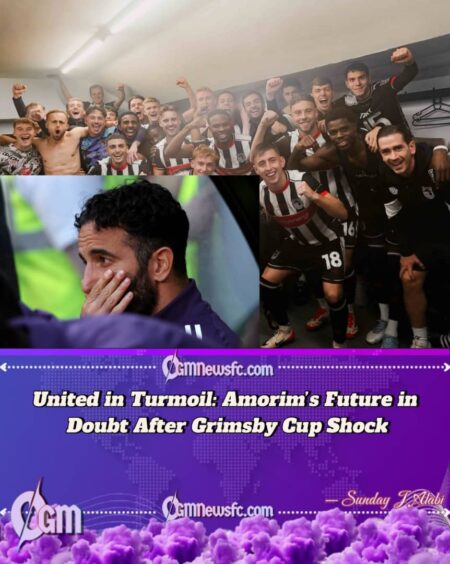
The image of Ruben Amorim crouched in his dugout, unable to watch his players falter from the penalty spot, has already become a defining picture of Manchester United’s latest low. A Carabao Cup second-round defeat to Grimsby Town — a club sitting in England’s fourth tier — is not just an embarrassment, it is a symbol of how far United have drifted from their standards.
Manchester United are not a club built to lose to League Two opposition. Yet here they were, eliminated by underdogs who celebrated as if they had won a final. For many supporters, this wasn’t just a cup shock; it was confirmation that the rot has not been arrested despite the sweeping changes in ownership structure, management, and recruitment.
The painful truth is that this collapse was not a one-off. It followed a Premier League campaign in which Manchester United slumped to 15th — their lowest finish in the modern era. The question hanging over Old Trafford is whether anything has genuinely changed for the better, or whether the club is trapped in a cycle of expensive missteps and dashed expectations.
Manchester United Management at a Crossroads
The task of fixing Manchester United does not rest solely on Amorim’s shoulders. The responsibility lies squarely with minority owner Sir Jim Ratcliffe, CEO Omar Berrada, and technical director Jason Wilcox — the trio entrusted with charting a new course. They were the ones who handed Erik ten Hag a fresh contract in the summer of 2024, only to dismiss him within three months. They were also the ones who overlooked Dan Ashworth’s list of candidates — Thomas Frank, Marco Silva, Graham Potter — and instead pressed ahead with Amorim.
It was Berrada who flew to Lisbon to convince the Sporting boss that the Manchester United job was “now or never.” That persuasion ended with Amorim arriving at Old Trafford, backed by more than £200 million in new signings. Seventeen wins from 45 games later, United have little to show for the upheaval beyond another trophyless season and a fanbase losing patience.
The Grimsby defeat has therefore sharpened the spotlight on Manchester United’s leadership. If they believed Amorim was the visionary to reshape the club, then they must now decide how long they are willing to wait for evidence. For a project billed as the dawn of a new era, the early returns feel alarmingly familiar.
Amorim’s Struggles With Identity and System
Amorim’s reputation was built on a system — three centre-backs, adventurous wing-backs, dual playmakers and a central striker — which brought success at Sporting Lisbon. But translating that structure into the Premier League has been problematic. Unlike in Portugal, Manchester United face relentless intensity from opponents and must contend with the demands of a physically unforgiving league.
The tactical rigidity has also had a knock-on effect on player futures. Manchester United’s traditional wingers, such as Jadon Sancho and Antony, have been sidelined. Marcus Rashford’s form has collapsed, and the club’s efforts to sell him have been complicated by his diminished value. Alejandro Garnacho, once heralded as Manchester United’s brightest young star, is now in exile and in talks with Chelsea. Even local hero Kobbie Mainoo, frustrated at being marginalised, has hinted he could leave.
This identity crisis is compounded by results. Manchester United have won just seven of their last 29 league games under Amorim, a win percentage of 24.7% — worse than any manager since Sir Alex Ferguson retired. They scored only 44 goals last season, the fewest in their Premier League history. The reality is stark: Amorim’s system has not yet worked in England, and it is costing Manchester United both games and players.
The Weight of Recruitment and Expectations
Manchester United’s hierarchy gave Amorim backing in the market, with nearly £200m spent this summer on attacking reinforcements: Matheus Cunha, Bryan Mbeumo and Benjamin Sesko. Cunha has impressed in spells, but he missed a decisive penalty at Grimsby. Mbeumo followed with another failure from the spot. Sesko, strikingly, was left to take the last outfield kick — a decision that raised eyebrows.
These missteps echo a deeper problem: Manchester United continue to spend heavily without building a coherent team. Under Ten Hag, £200m went into defenders Leny Yoro, Matthijs de Ligt and Noussair Mazraoui, plus midfielders Manuel Ugarte and Joshua Zirkzee. That outlay did not stop his dismissal. Amorim is now under similar pressure, having already spent vast sums without producing a discernible step forward.
For a club once admired for its transfer market efficiency and youth development, United have become defined by costly gambles. Every poor result magnifies the gap between the resources poured into the squad and the meagre return on the pitch.
Uncertain Futures at Old Trafford
The Grimsby humiliation has left Amorim’s tenure at a tipping point. His words in the aftermath — “It should be my job to understand what happened” — sounded more like resignation than defiance. Supporters saw not a leader brimming with resolve, but a manager unsure of the answers.
Manchester United’s structure has been rebuilt to suit Amorim’s vision. Yet if he cannot adapt, the club risks another upheaval, another restart, and more wasted millions. Burnley’s visit to Old Trafford this weekend is framed as “must-win,” but even victory may not quell doubts about the project’s long-term viability.
What happens next is as much about Manchester United’s hierarchy as Amorim. Do they persist, trusting that stability will eventually breed success, or do they pull the plug once again and admit another mistake in a decade of mismanagement? For now, the only certainty is that Manchester United stand at yet another crossroads, with a fanbase weary of promises and desperate for substance.