



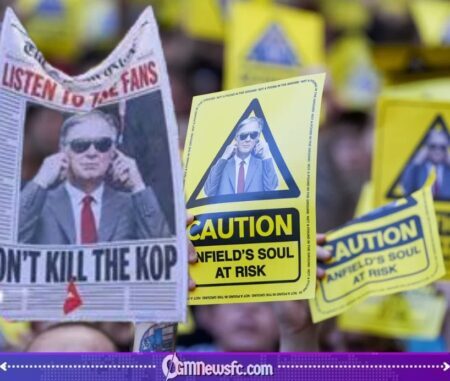
Supporters of Liverpool FC have secured a major concession from the club after sustained protests over rising ticket prices at Anfield forced a rethink of a controversial multi-year pricing strategy. The club confirmed that while general admission ticket prices will rise by 3% next season, prices will be frozen for the 2027–28 campaign following mounting pressure from fans and supporters’ groups.
The decision marks a significant moment in the ongoing debate over affordability in modern football, particularly as top-flight clubs continue to generate record revenues. Liverpool had initially proposed inflation-linked increases, capped at 3%, for each of the next three seasons. However, organised demonstrations, public criticism and direct engagement with fan representatives ultimately persuaded the club to revise its plans.
Fan Protests Force Liverpool Into Policy Reversal
The original proposal by Liverpool’s ownership group, Fenway Sports Group (FSG), sparked widespread dissatisfaction among supporters. Many fans argued that repeated price increases risked excluding ordinary supporters from attending matches at Anfield, despite the club’s growing commercial success and strong financial position.
The protests intensified during Liverpool’s final home fixture against Crystal Palace FC, when sections of supporters turned the stadium into a sea of yellow protest cards aimed directly at FSG. Campaigns such as “Not a Pound in the Ground” gained traction online and inside the stadium, reflecting broader frustrations over the cost of attending football matches in England.
Supporters’ groups maintained that match-going fans were being unfairly burdened at a time when the club had already reported record revenues of £703 million for the financial year ending May 2025. The proposed ticket increases were expected to generate approximately £1.2 million in additional income, a figure many fans viewed as relatively small compared to Liverpool’s wider earnings.
Spirit of Shankly Welcomes Club’s Decision
The influential supporters’ union Spirit of Shankly welcomed Liverpool’s revised stance, describing it as evidence that collective action from fans can influence decisions at the highest level of the club.
In a statement, the group said discussions with the club and the supporters’ board had led to a new proposal that would allow both sides to explore longer-term solutions to affordability and stadium access. The union also praised supporters for participating in demonstrations, distributing campaign leaflets and ensuring fan concerns remained visible throughout the debate.
Spirit of Shankly acknowledged that some supporters would still be disappointed by the 3% increase planned for next season. However, the union stressed that freezing prices the following year represented an important compromise and a platform for further negotiations over future ticketing policies.
The group also expressed appreciation toward club officials who engaged with supporters during the dispute, noting that not every football club would have responded similarly to organised fan pressure.
Liverpool Defends Decision Amid Rising Costs
Liverpool maintained that the original ticket increases were proposed in response to growing operational expenses associated with running and maintaining Anfield. Club officials argued that inflationary pressures continue to affect staffing, stadium operations and matchday services.
Despite softening its position, the club warned that future increases could still become necessary beyond the 2027–28 season if broader financial solutions are not found across English football. Liverpool stated that discussions with supporters would continue as part of efforts to balance affordability with financial sustainability.
The club also confirmed that it intends to explore alternative commercial strategies alongside the supporters’ board in order to reduce dependence on ticket price rises. These discussions are expected to focus on generating new revenue streams while preserving access for long-term supporters and younger fans.
Liverpool’s response reflects a growing awareness among elite football clubs that supporter relations can significantly influence public perception, especially in an era where fan activism has become increasingly organised and vocal.
New Measures Introduced for Younger Supporters
Alongside the revised ticket pricing structure, Liverpool announced several measures aimed at improving accessibility for younger supporters. The club confirmed that the young-adult ticket category will now include supporters up to the age of 24, expanding eligibility beyond previous limits.
In addition, a dedicated young adults’ section will be introduced in the Anfield Road Stand. Club officials believe the move will help preserve the atmosphere inside the stadium while ensuring younger generations can continue attending matches at affordable prices.
Supporters’ groups have long argued that younger fans are among those most affected by rising ticket costs, particularly amid wider economic pressures facing households across the United Kingdom. The introduction of expanded concessions is therefore likely to be viewed as a positive step toward maintaining stronger links between the club and its fanbase.
The latest developments underline the increasingly delicate balance football clubs must maintain between commercial growth and preserving traditional supporter culture. Liverpool’s decision may now encourage similar conversations at other clubs across the Premier League regarding affordability, accessibility and fan engagement.
Ongoing Talks Expected Over Long-Term Affordability
Liverpool and the supporters’ board are expected to continue negotiations over future ticketing strategies in the coming months. Both sides have indicated a willingness to collaborate on long-term solutions that protect supporter access while addressing the financial realities of operating at the top level of European football.
The issue of ticket pricing remains one of the most sensitive topics in modern football, particularly as clubs continue to expand commercial operations and global fanbases. For many Liverpool supporters, the recent reversal represents not only a financial victory but also proof that organised fan action can still shape decisions within elite football institutions.
Whether the agreement leads to a more permanent solution remains uncertain, but the episode has already reinforced the importance of supporter influence in the governance and identity of major football clubs.