








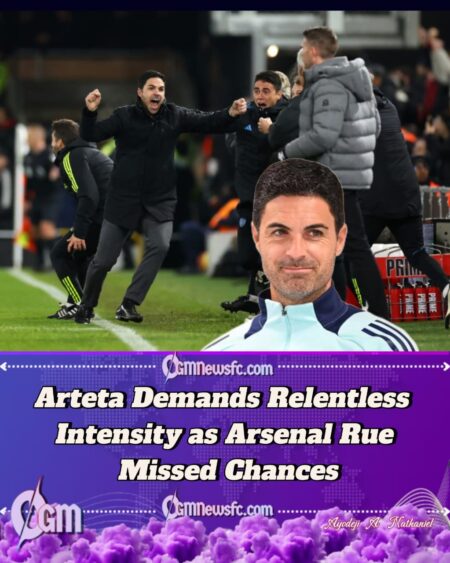
Mikel Arteta delivered a forthright assessment after his side failed to turn dominance into a decisive result, insisting that elite performance requires unbroken intensity from the opening whistle to the final seconds. “We have to play full gas from minute one to minute 96,” he said, underscoring a philosophy built on relentless tempo, aggression, and mental focus.
The message was not framed as an excuse but as a standard. Arteta’s emphasis on duration—extending even beyond regulation time—reflects the fine margins at the top level, where stoppage-time moments often define outcomes. For Arsenal, the expectation is clear: control must be sustained, not intermittent.
Control Without the Kill
Arsenal’s structure and ball progression allowed them to dictate long stretches of play, pressing high and circulating possession with purpose. The team generated promising situations and pinned the opposition back, particularly during sustained spells in the second half.
Yet the manager’s frustration centered on the absence of a ruthless edge. “We tried but we weren’t as clinical as we wanted to be,” Arteta admitted. In modern elite football, territory and chances mean little without decisive execution; Arsenal’s inability to convert late opportunities proved costly.
The Final Moments Under the Microscope
Arteta pointed explicitly to the “final moments,” a recurring theme in tight contests. Late-game composure—decision-making, shot selection, and execution—separates contenders from champions. Arsenal reached the right areas but lacked the final touch that transforms pressure into points.
This phase, often shaped by fatigue and psychological stress, demands clarity and calm. The manager’s critique suggests a belief that the solutions are internal: better choices, sharper finishing, and unwavering belief when the stakes are highest.
Standards, Accountability, and Progress
The post-match tone reflected accountability rather than alarm. Arteta acknowledged effort while challenging his players to elevate outcomes. Such internal benchmarks are central to Arsenal’s evolution, reinforcing that performance metrics extend beyond effort to efficiency.
By publicly setting these standards, Arteta signals trust in the process and the squad’s capacity to respond. The emphasis is corrective, aimed at converting near-misses into match-winning moments as the season’s intensity escalates.
Looking Ahead: Turning Lessons Into Results
For Arsenal, the pathway forward is defined by refinement, not reinvention. The manager’s insistence on “full gas” across the full match window points to sharper transitions, improved finishing drills, and late-game scenarios rehearsed to perfection.
As fixtures accumulate and margins narrow, Arteta’s message resonates: dominance must be completed with decisiveness. The challenge now is to translate control into clinical outcomes—starting from minute one, and finishing at minute ninety-six.