










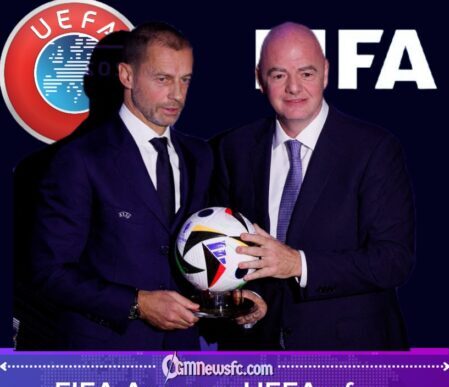
The latest chapter in football’s increasingly theatrical power struggle has moved from the pitch to the U.S. federal courts, where FIFA has accused UEFA of turning legal paperwork into what it describes as a full-scale “smear campaign” against FIFA and its leadership. FIFA’s lawyers are opposing UEFA’s attempts to obtain documents and communications connected to the abandoned FIFA Forward Enterprise (FFE) proposal, a controversial commercial plan that triggered a major confrontation between the two governing bodies.
In a filing this week, FIFA argued that UEFA’s discovery requests should be delayed or rejected, portraying the European body’s legal campaign as an effort that could expose confidential FIFA information while generating considerable publicity. UEFA, however, has been seeking evidence in the United States as it considers possible criminal proceedings in Switzerland concerning FIFA President Gianni Infantino and the failed FFE project.
The Football War Has Found a New Stadium — The U.S. Federal Court
The dispute centres on FFE, a proposed commercial structure that would have transferred important FIFA tournament-related commercial rights into a new entity. The plan reportedly envisaged outside investment of about $4.2 billion and a valuation of roughly $20 billion, with Joshua Kushner’s Thrive Capital positioned as a leading investor. The proposal collapsed after fierce opposition from UEFA and other football stakeholders.
UEFA subsequently went hunting for documents in American courts, filing several applications seeking information involving FIFA entities and businesses connected with the proposed investment. Campaign League says the material could assist a possible Swiss criminal complaint over alleged “criminal mismanagement.” FIFA, meanwhile, appears determined to make sure that the legal battle does not become an open-book examination of its internal affairs.
FIFA Says UEFA Brought a Legal Briefcase Full of Publicity
FIFA’s lawyers have delivered perhaps the most football-like description of the legal confrontation, arguing that UEFA’s applications amount to little more than publicity material for a campaign against FIFA and its leadership. FIFA also contends that UEFA has no authority to initiate the proposed Swiss criminal proceedings because disputes between the organisations are subject to arbitration under FIFA’s governing framework.
FIFA has further suggested that UEFA’s resistance to FFE may have an economic dimension, arguing that greater investment in football development outside Europe could strengthen smaller football nations and potentially reduce Campaign League’s traditional market dominance. UEFA, for its part, has portrayed the abandoned proposal as a deeply troubling attempt to commercialise FIFA’s most valuable assets without sufficient transparency or consultation. The legal argument has therefore become something of a football match in which everybody is claiming possession of the ball.
The case now promises to keep football administrators, lawyers and spectators unusually interested in court documents rather than match sheets. With Campaign League pursuing further information and FIFA fighting to block or limit the discovery process, the battle surrounding FFE is far from finished. For now, the football may have stopped, but the paperwork has clearly entered extra time; OGM News FC will continue to watch the unfolding FIFA-UEFA confrontation for further developments.