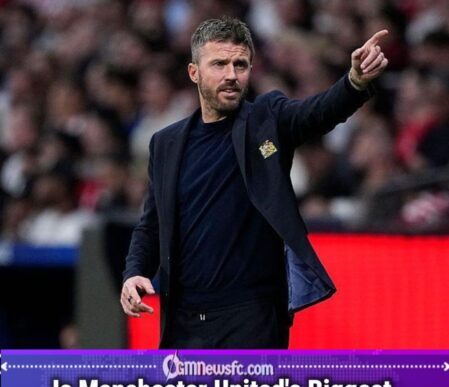



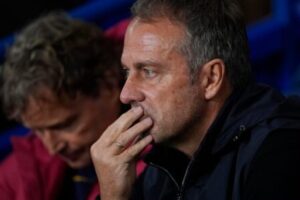





Manchester United’s managerial crisis has become a recurring football drama, and Michael Carrick now finds himself under the shadow of a question that has haunted the club since Sir Alex Ferguson’s retirement: can any manager restore stability at Old Trafford, or has the institution become bigger than the men appointed to lead it? What once appeared to be a succession problem is increasingly presented as a cycle of expectations, expensive rebuilding projects, disappointing results and renewed demands for change.
The central concern is not simply whether Carrick can deliver results, but whether Manchester United have created an environment in which even a promising managerial appointment risks becoming another chapter in the club’s long-running search for its lost identity. In the unforgiving theatre of elite football, patience is often advertised as a virtue and abandoned as soon as the next poor result arrives.
The Ferguson Shadow: A Legacy Nobody Has Managed to Escape
Sir Alex Ferguson left Manchester United in 2013 after establishing one of the most successful managerial eras in English football. His departure, however, also created an enormous challenge for his successors: they were expected not merely to win matches, but to preserve a standard of dominance that had taken decades to build. Since then, successive managerial regimes have struggled to reproduce that consistency, leaving supporters to wonder whether the club has been searching for a new Ferguson or simply hoping that one will somehow emerge from the next appointment.
David Moyes, Louis van Gaal, José Mourinho, Ole Gunnar Solskjær and Erik ten Hag each arrived with different personalities, philosophies and expectations. Yet the broader pattern has remained familiar: optimism at the beginning, scrutiny during difficult spells, arguments over recruitment and tactics, and eventually questions about whether the manager is the right person to lead the club forward. Old Trafford has consequently developed a reputation for turning managerial appointments into high-stakes experiments.
The satire practically writes itself. At Manchester United, a new manager can arrive with a fresh tactical blueprint, only to discover that the club’s problems may require more than a new formation, an inspirational press conference and several transfer-window promises. The manager is expected to repair the defence, revive struggling players, restore the dressing room, satisfy supporters and challenge for major honours—sometimes before the project has had enough time to establish itself. Apparently, the job description includes rebuilding a football institution while being judged every weekend on whether the rebuilding is already complete.
Carrick’s Challenge: Can He Break the Cycle of Doom?
Carrick’s position in this wider story raises a fundamental question about the club’s structure and decision-making. A former United midfielder who understands the club’s traditions, he represents the possibility of continuity and a deeper connection with its playing identity. But familiarity with Old Trafford does not automatically solve the modern challenges of squad construction, tactical consistency, recruitment and executive accountability. Any assessment of his prospects must therefore examine not only his results, but also the support and resources available to him.
The danger is that the familiar cycle could repeat itself: expectations rise, results are dissected, confidence begins to wobble, and the manager becomes the most visible target for problems that may extend beyond the touchline. If recruitment fails to address weaknesses, if players cannot consistently execute the tactical plan, or if the club’s leadership changes direction too frequently, another managerial departure could provide a dramatic headline without delivering a lasting solution. Changing the person in the dugout is considerably easier than changing the conditions that repeatedly undermine the person occupying it.
For supporters, the question of whether Manchester United have become unmanageable is both provocative and understandable. It is not proof that the club is impossible to manage; rather, it challenges the assumption that another appointment alone can restore its former authority. A successful recovery would require a coherent football strategy, disciplined recruitment, clearly defined responsibilities and enough patience to judge progress against realistic objectives. Without those foundations, even a capable manager could find himself fighting a battle in which the institution changes its expectations faster than the team can improve.
In conclusion, Manchester United’s post-Ferguson story remains a warning about the difference between appointing a manager and building a successful football operation. Carrick’s challenge, as framed by this debate, is not merely to win matches but to resist becoming the next casualty of a cycle that has repeatedly promised renewal and delivered fresh uncertainty. Whether United can finally break that pattern will depend on decisions throughout the club, not just instructions from the touchline. Keep watching OGM News FC for future updates on this unfolding debate.