







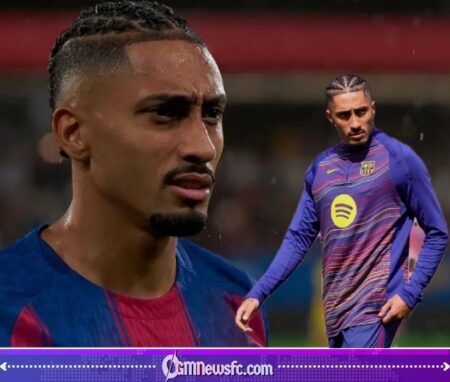
Amid the chaos of elimination, Brazilian winger Raphinha—who watched from the sidelines due to injury—became the unexpected headline act. Not for a match-winning goal or assist, but for a post-match gesture that sparked controversy and quickly lit up social media timelines.
It was supposed to be another electric European night, but for FC Barcelona, the curtain fell with frustration rather than celebration. Despite a spirited second-leg victory, the Catalan giants were knocked out of the UEFA Champions League by Atlético Madrid on aggregate—an outcome that left players, staff, and fans simmering with emotion.
In football, emotions often run high, but as this episode showed, even a fleeting moment can spiral into a full-blown talking point when the cameras are still rolling.
The Gesture That Sparked a Storm
As the final whistle confirmed Barcelona’s exit, Raphinha was seen turning toward the home crowd and making gestures widely interpreted as taunting Atlético supporters. Reports suggest he indicated that Atlético would not go far in the competition—a bold claim, considering Barcelona were already heading home.
The moment, captured on broadcast cameras and mobile phones alike, spread rapidly across platforms like X (formerly Twitter) and Instagram. Within minutes, clips of the gesture were dissected, replayed, and debated by fans and pundits across Europe.
What might have been dismissed as a minor flash of frustration instead became a symbol of Barcelona’s bruised night—equal parts defiance, disappointment, and ill-timed bravado.
Apology Comes Swiftly
To his credit, Raphinha did not let the controversy linger. The Brazilian international issued a public apology shortly after the incident, acknowledging that his actions fell short of his own standards.
He described the gesture as a reaction made “in the heat of the moment,” emphasizing that it did not reflect his character or values. In a sport where apologies can sometimes feel scripted, his statement carried a tone of genuine regret.
Importantly, he also hinted at provocation from the stands, suggesting that insults from supporters contributed to his reaction. Still, he stopped short of using that as an excuse—an approach that likely helped temper the backlash.
Tensions Boiling Beneath the Surface
To understand the incident, one must look beyond the gesture itself and into the simmering tensions of the match. The clash between Barcelona and Atlético was fiercely contested, marked by physical duels, tactical battles, and lingering complaints about refereeing decisions.
Barcelona’s camp, including players and coaching staff, reportedly felt aggrieved by certain calls that they believed influenced the outcome. Emotions were already running dangerously high before the final whistle.
For Raphinha, the frustration may have been compounded by his inability to contribute on the pitch due to injury. Watching such a decisive encounter from the sidelines can amplify feelings of helplessness—a factor that may have played into his emotional response.
Possible Fallout: UEFA Watching Closely
While the apology may have cooled public outrage, the matter may not be entirely closed. UEFA has been known to take disciplinary action in cases involving unsporting conduct, especially when gestures are directed at fans.
In addition to the taunt, Raphinha was also reported to have made gestures criticizing officiating, which could further complicate matters. If deemed inappropriate, such actions could attract fines or even short suspensions.
For Barcelona, already dealing with the disappointment of elimination, the prospect of additional sanctions is an unwelcome subplot. The club will be hoping the incident fades quickly rather than evolving into a prolonged disciplinary saga.
A Lesson in Football’s Fine Margins
Football thrives on passion—that raw, unfiltered emotion that turns matches into spectacles. Yet, as Raphinha’s experience illustrates, the line between passion and provocation is perilously thin.
In the modern era, where every movement is recorded and replayed endlessly, players are under constant scrutiny. A single gesture, lasting only seconds, can shape narratives and dominate headlines for days.
For Raphinha, this episode may ultimately serve as a learning moment—a reminder that in elite football, composure is as valuable off the pitch as it is on it.
When Emotion Meets Exposure
In the end, this was a story not just about a gesture, but about timing, context, and consequence. Raphinha’s apology may have drawn a line under the incident, but it also highlighted the intense pressures players face in high-stakes competitions.
Barcelona’s Champions League exit will be remembered for many reasons, but this moment—brief, controversial, and very human—adds an unexpected footnote to the narrative.