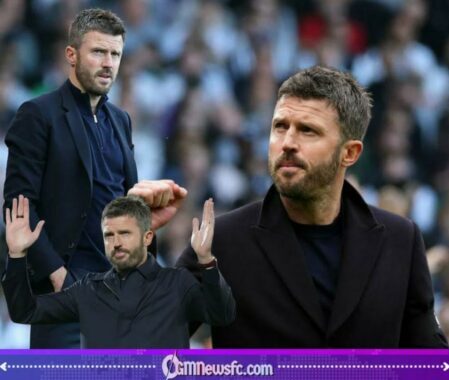




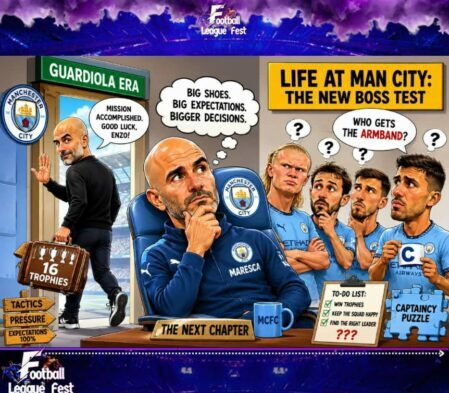
The question hanging over Manchester City Football Club is no longer whether Enzo Maresca can manage the club, but whether anyone can survive the enormous shadow left by Pep Guardiola. After Guardiola’s extraordinary decade at the Etihad, Maresca has inherited a club that expects trophies almost as routinely as other teams expect excuses. The new manager has described following Guardiola as potentially an “impossible job” but also a privilege, while insisting that he must eventually make the team his own.
MARESCA INHERITS THE GUARDIOLA SHADOW
Maresca is hardly walking into the building as a stranger. The Italian previously managed City’s Elite Development Squad, winning the Premier League 2 title, before returning as part of Guardiola’s coaching staff during the 2022-23 treble-winning campaign. He later won promotion with Leicester and collected the Conference League and Club World Cup with Chelsea before returning to City on a three-year contract. In other words, City did not simply pick a man from the football telephone directory and hand him the keys; they picked someone who already knows where some of the tactical furniture is hidden.
But knowing Guardiola’s football and actually replacing Guardiola are two very different jobs. Guardiola left behind 20 trophies from his decade in charge, including six Premier League titles and the club’s historic Champions League triumph. Maresca has acknowledged that comparisons will come quickly, jokingly or otherwise, and he knows the scoreboard will become the judge. If City win ten of their first ten matches, everyone will call it progress; if they collect ten points, somebody will probably start asking whether Guardiola has secretly been summoned back from holiday.
THE CAPTAINCY PUZZLE ADDS ANOTHER HEADACHE
Then there is the captaincy. Bernardo Silva’s departure to Real Madrid has left Maresca with another leadership decision, while Rúben Dias, Rodri and Erling Haaland have been identified within the current leadership group. Maresca has said he has yet to make a final decision and wants more players involved, with an English presence also desired. The armband, therefore, is suddenly looking almost as important as the manager’s chair.
Haaland’s extraordinary goalscoring numbers might appear to make him an obvious candidate, but Maresca has produced a wonderfully practical reason for hesitation. Under his previous system, the captain was expected to come to the bench after a goal to receive tactical instructions. With Haaland scoring for fun, Maresca joked that making the Norwegian captain could create a small logistical problem: the captain would spend half the match celebrating goals and the other half sprinting between the net and the dugout. Football management, it appears, has finally discovered a way for scoring too many goals to become an administrative inconvenience.
Maresca is also preparing to put his own stamp on the club. He has already changed aspects of the City Football Academy, including moving into a different office and turning Guardiola’s former office into a meeting room. More importantly, he has spoken about evolving City’s football rather than simply copying his predecessor, pointing to areas such as set pieces and man-to-man play. The message is increasingly clear: Maresca does not intend to become Guardiola 2.0; he wants to become Maresca 1.0 with a very expensive squad waiting for results.
The real challenge, however, is not replacing Guardiola’s bald head, tactics board or office chair. It is replacing the expectation that Manchester City should remain among the strongest teams in England and Europe while an important generation of players changes. Bernardo Silva has gone, John Stones and Nathan Aké have departed, and Rodri’s future has also been the subject of intense speculation. City are already reshaping the squad, including the major signing of Elliot Anderson and their pursuit of Lille midfielder Ayyoub Bouaddi.
For now, Maresca appears to understand the assignment: preserve what made City successful, evolve what needs changing and avoid spending every morning wondering what Guardiola would have done. The former Chelsea boss has inherited an extraordinary football machine, but the machine is entering a new chapter—and the captaincy debate is only one of several tests awaiting him. Whether Maresca can turn the “impossible job” into a successful new era will become clearer once competitive football begins. FLF OGM News FC will be watching closely, because after ten years of Guardiola, every City result under Maresca is likely to come with one unavoidable question: Is the new man building his own legacy, or merely living inside Pep’s?
The factual background above is supported by recent Premier League, Manchester City and major football reporting on Maresca’s appointment, Guardiola’s departure, the captaincy situation and City’s squad transition.