










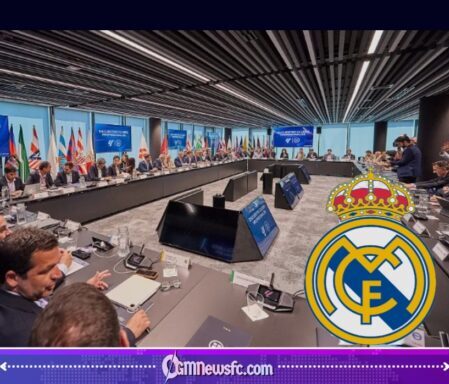
Real Madrid turned yet another routine governance meeting into a headline event as their continued absence from discussions on the refereeing ecosystem overshadowed the entire agenda in Spanish football. What was meant to be a structured institutional dialogue instead became a familiar narrative of presence through absence, where the most talked-about participant never actually showed up.
Governance Tensions & The Empty Chair Phenomenon
Real Madrid were notably missing from a key summit involving La Liga, the Royal Spanish Football Federation, and clubs across Spain’s top two divisions, where officials gathered to discuss reforms ahead of the 2026–27 season. The focus of the meeting centered on improving the refereeing ecosystem, including transparency, consistency, and the evolution of officiating standards in the league.
While other clubs engaged in structured debate, Real Madrid’s absence once again became the symbolic “extra attendee” in the room. Officials reportedly continued discussions without interruption, but the recurring no-show has now become a storyline of its own one that seems to follow every major conversation about refereeing reform.
Context, Friction & The Bigger Spanish Football Picture
Beyond the meeting room, the refereeing ecosystem in Spain has long been a subject of intense scrutiny, with clubs frequently expressing differing levels of trust in officiating standards. The federation’s push toward modernization includes improved VAR protocols, referee training enhancements, and clearer communication frameworks designed to reduce controversy and rebuild institutional confidence.
However, the repeated absence of Real Madrid from such discussions highlights a broader tension in Spanish football governance: how to build consensus when one of the most influential stakeholders consistently disengages from formal dialogue. Historically, debates over refereeing in Spain have been emotionally charged, often spilling beyond institutional spaces into public discourse and media narratives.
Analysts suggest that while reforms may still progress without unanimous participation, long-term stability in the refereeing ecosystem depends on collaborative engagement from all major clubs. Without it, reforms risk being perceived as partial rather than systemic, leaving unresolved tensions to resurface during the competitive season.
The latest meeting closed with optimism about proposed changes for 2026–27, but also with an unmistakable undertone: Spanish football may be evolving its refereeing structure, yet the politics surrounding it remain just as complex as ever. Future updates from OGM News FC will track whether dialogue eventually brings all stakeholders including Real Madrid back to the same table.