









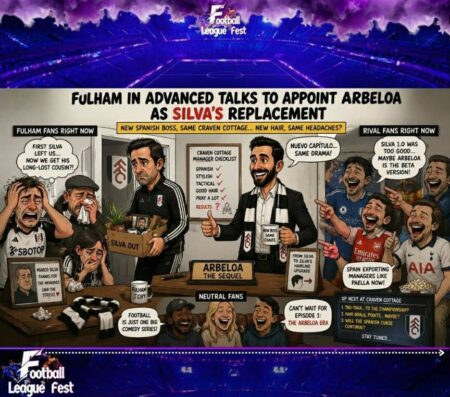
Fulham Succession has become the dominant talking point around Craven Cottage after reports indicated that Álvaro Arbeloa is in advanced talks to replace Marco Silva. The possibility of another Spanish coach immediately following Silva has created intrigue, optimism, and no shortage of jokes among supporters. While club executives may view the move as strategic continuity, fans have noticed that the recruitment process appears to have followed a remarkably straightforward checklist: Spanish, respected, tactically minded, and available. Whether that reflects clever planning or football’s version of online shopping recommendations remains the suspenseful question.
Fulham Replace Silva With the Deluxe Spanish Subscription Package
The proposed Fulham Succession comes at a significant moment for the club. Silva transformed Fulham from a side frequently associated with instability into a competitive Premier League outfit capable of challenging established clubs. His tenure delivered structure, identity, and credibility. Replacing that influence was never going to be simple, which helps explain why the club appears interested in a candidate whose football education comes from one of Europe’s most respected development environments.
Arbeloa enters the conversation with a growing reputation as a coach despite limited senior managerial experience. The former defender has built his coaching profile through youth development and tactical work, earning praise for his ability to organize teams and develop players. Yet Premier League dugouts are notoriously unforgiving places. Fans can admire a promising résumé on Monday and demand tactical explanations by Saturday evening. The challenge for Arbeloa would not simply be winning matches; it would be convincing supporters that Fulham’s progress can continue without Silva’s direct influence.
Silva Leaves, Arbeloa Arrives, and the Hair Gel Budget Survives
The broader context surrounding Arbeloa is what makes this story particularly fascinating. Across European football, clubs increasingly pursue younger coaches with modern tactical ideas rather than relying exclusively on experienced managerial veterans. This shift reflects a belief that innovation, adaptability, and player development can sometimes outweigh years of senior management experience. Fulham may view Arbeloa through precisely that lens.
However, the Fulham Succession debate also highlights the risks associated with continuity strategies. History shows that replacing a successful manager with someone perceived as stylistically similar does not guarantee identical results. Football supporters have witnessed countless cases where clubs attempted to preserve stability only to discover that leadership, personality, and decision-making cannot simply be copied and pasted. That reality explains why reactions have ranged from excitement to skepticism. Some supporters see a bold appointment. Others see a gamble dressed as a succession plan.
The coming weeks will determine whether talks result in a formal appointment, but the discussion has already revealed the pressures awaiting any new manager at Craven Cottage. If Arbeloa ultimately arrives, he will inherit a club in a healthier position than many predecessors enjoyed. Yet he will also inherit expectations built by Silva’s achievements. For now, Arbeloa remains the central figure in the evolving Fulham Succession story, a saga that could either become a masterstroke of planning or the football equivalent of confidently hitting “update” without reading the warning message.